

ECB vulnerability standards from January 2027: what should enforcement firms check in their letters?
Enforcement Conduct Board (ECB) vulnerability standards start in January 2027. Seven practical checks for enforcement letters, contact routes and records.

The customer is holding the letter. Can your agent see it?
When a customer calls about a letter, can your agent see the same document? A practical check of contact-centre access, guidance and communication records.

One sentence, 36 places: why small wording changes take so long
One wording change can affect dozens of separately maintained versions. Count where a sentence lives, review each format and coordinate its release.

You reviewed the change. Did anyone read the whole letter?
A tracked change can be right on its own and still contradict the rest of the letter. Five signals that call for a full read, and what to record.
Regulation F validation notices: did you test the generated output?
Test generated Regulation F validation notices for long names, itemization fields and page breaks. Connect the reviewed output to the approved template version.

Forbearance letter wording: can the customer understand the support offered?
Review forbearance letters against the support offered. Check payment terms, balance and credit-file explanations, and keep creditor and agency wording aligned.

FCA information request deadlines: how to assemble the letter evidence pack
Responding to an FCA information request? Check which deadline applies and assemble a letter evidence pack linking approvals, generation, output and sending.
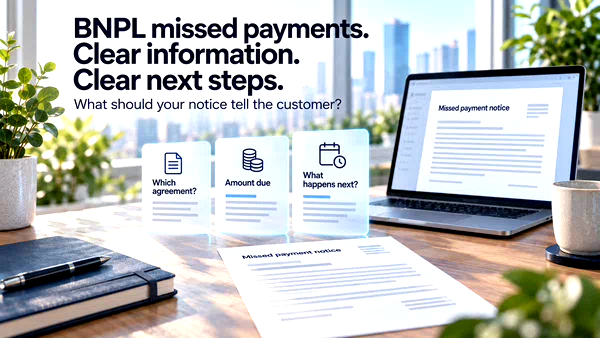
BNPL missed-payment notice: what CONC 7.20 requires
What FCA rule CONC 7.20.1R requires a missed-payment notice on regulated deferred payment credit to tell the customer, and how to check yours.
BNPL collections handover: what notice evidence should travel with the account?
What notice evidence should travel with a BNPL account? A practical checklist covering approved versions, generation records, retained outputs and sending results.

AI writes the wording. Who approves it?
AI can improve customer wording. Learn how human approvals, template versions and generation evidence help teams control what is used.
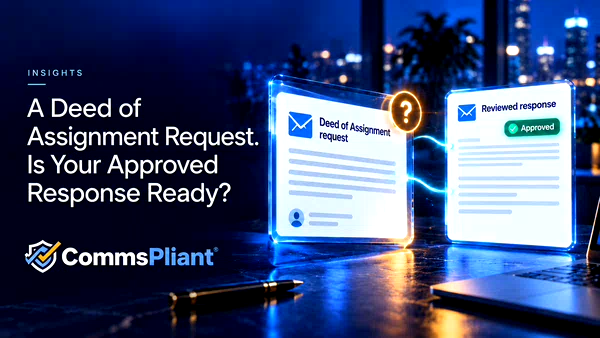
When a Customer Demands a Deed of Assignment: Is Your Approved Response Ready?
CSA guidance on Deed of Assignment myths, genuine subject access requests and keeping collections responses appropriate, approved and traceable.
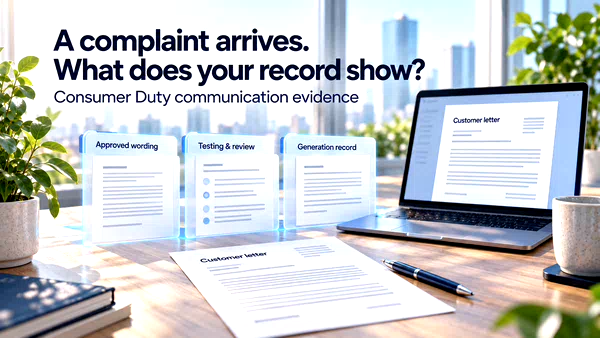
Consumer Duty communications evidence: what should your record show when a complaint arrives?
What the Consumer Duty and DISP expect when a complaint questions an arrears letter, what the FCA found in March 2026, and what your record should show.
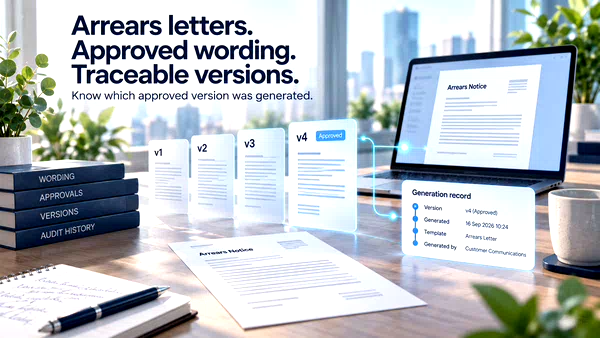
CONC 7 arrears communications: what rules apply, and which approved version was generated?
What the CCA and CONC 7 require in arrears communications, and how collections teams can show which approved version generated each letter.
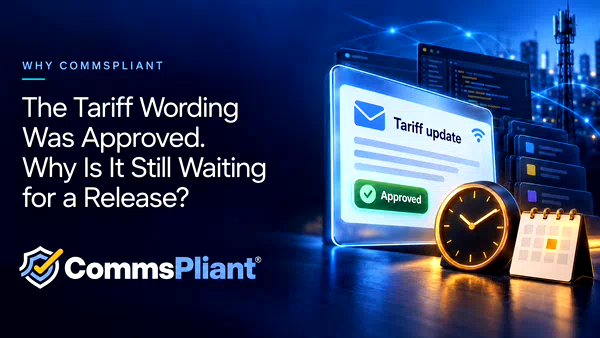
The Tariff Wording Was Approved. Why Is It Still Waiting for a Release?
Update tariff email wording through version control and human approval in CommsPliant, without a software release for supported template changes.

Incident Communications, Managed Together
Bring internal teams and external partners together to review and approve incident communications, with version history and the CommsPliant Evidence Vault.

One Customer Email, Three Teams, One Approval Workflow
See how three teams can review and approve one customer email during a broadband outage, with version history and a connected CommsPliant evidence record.
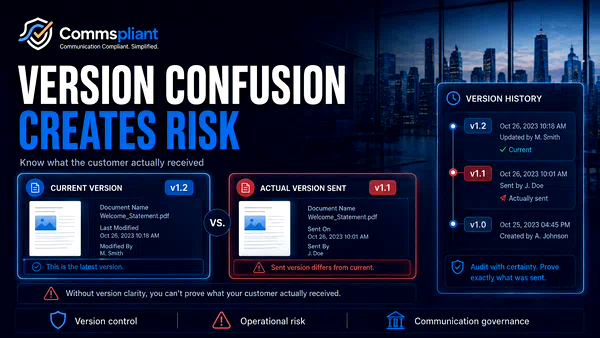
Why Version Confusion Creates Risk in Regulated Communications
Version confusion in customer emails, PDFs and letters can create operational risk. Learn why regulated teams need controlled version history and clearer publication workflows.

When the Real Compliance Problem Is Proving Who Changed What
When approvals are questioned later, can you prove who changed, reviewed and approved the exact version? Explore the communication evidence problem.

Compliance approved the wording in a day. Going live took five.
Compliance approved the wording on day one. Why did release take five? See where the delay happens and how CommsPliant cuts the release bottleneck.
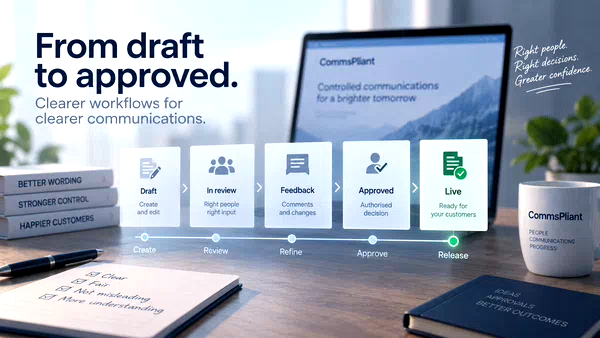
What an Approved Wording Workflow Needs to Record
Learn what a controlled customer communication approval workflow should record, from exact version and change history to review, approval and release.
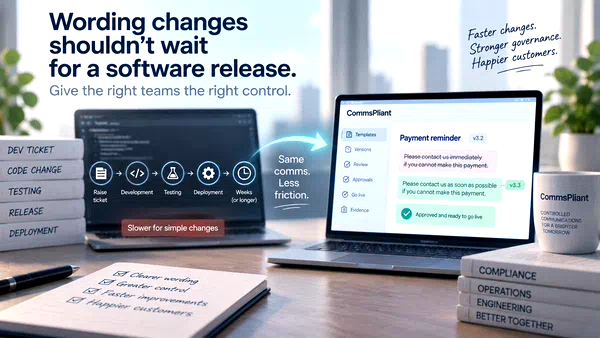
When a Wording Change Should Not Wait for a Software Release
Why customer wording changes should not always need a developer ticket and deployment, and when engineering still needs to be involved.
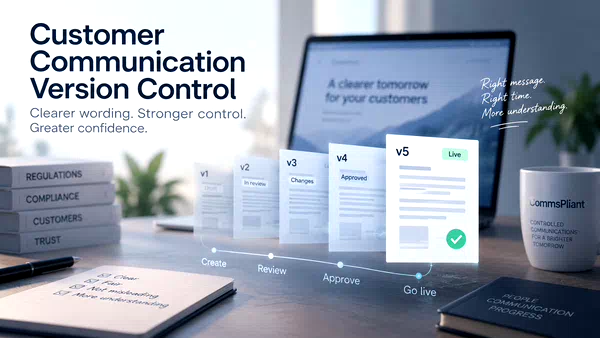
Customer Communication Version Control: What It Is and Why It Matters
Learn how version control works for regulated customer communications, from wording changes and approvals to generation records and audit evidence.
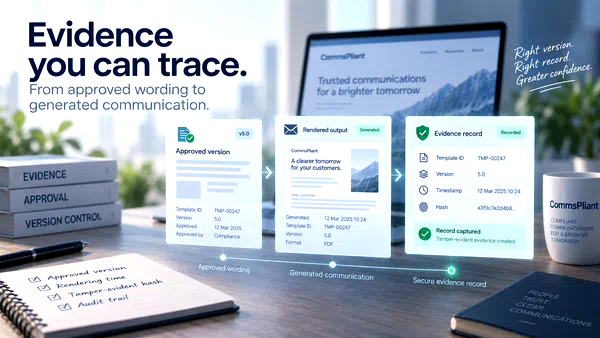
How to Evidence a Generated Customer Communication
Learn what evidence can connect a generated customer communication to its approved template version, rendering event and audit history.

Revolut’s Data Breach and the Risk of Trusting an Official Email
Revolut’s reported data breach highlights the need for requester verification, controlled disclosures and audit evidence when handling customer information.

When AI Sounds Regulated: The FCA’s Warning on Investor Trust
FCA research reveals misconceptions about AI financial information. What should firms check when AI helps shape customer communications?

When Systems Fail, Who Approves the Customer Update?
The FCA’s resilience exercise raises a practical question: can your team prepare, approve and track customer updates when disruption affects several firms?

£4.7 Million: When Regulatory Change Outruns Operational Controls
Explore Citibank’s £4.7m sanctions penalty, OFSI’s findings and the practical lessons for regulatory change, operational controls and communication governance.

When One Mobile Mast Fails: What Ofcom’s Proposed Incident-Reporting Changes Could Mean
Ofcom is proposing new mobile and rural telecoms incident-reporting thresholds. See what providers should understand and prepare for.

The FCC's New Submarine Cable Security Regime: What Changes on 25 September—and What Comes Later
The FCC's submarine cable security order has a September 2026 general effective date, but many operational requirements remain delayed indefinitely. Here's what takes effect and what remains pending.

When the Evidence Disappears, Oversight Disappears With It
An FCA pension transfer case shows why effective oversight depends on aligned permissions, protected records and evidence that can be reconstructed.

Which Version Did the Customer See?
When approved wording reaches email, portal and PDF at different times, customers can see different versions. See how CommsPliant helps keep them aligned.

One Name on the Approval Log
One name on an approval log doesn't prove independent review. Learn why segregation of duties matters and how to enforce it as a workflow rule.
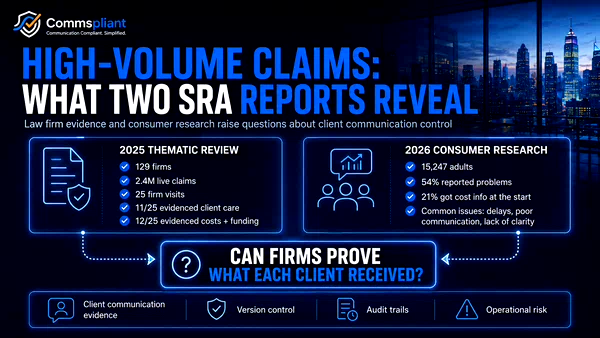
High-Volume Consumer Claims: What Two SRA Reports Reveal About Client Communication Evidence
A practical overview of two SRA reports on high-volume consumer claims, what they found about law firm practices and consumer experiences, and why firms need reliable evidence of what each client received.
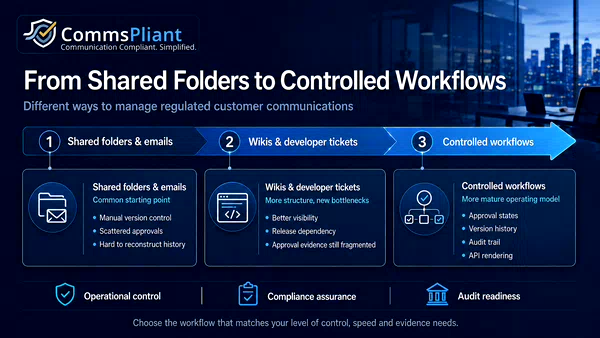
Different Ways to Manage Regulated Customer Communications: From Shared Folders to Controlled Workflows
Regulated teams manage customer emails, PDFs and letters in many ways, from shared folders and email approvals to developer tickets and controlled workflows. This article compares the strengths, limits and risks of each approach.

When Council Letters Become Harder Than They Need to Be
Small councils often manage recurring letters across spreadsheets, CSV files and manual processes. See how CommsPliant can simplify control, approval and evidence.

When a Customer Complaint Becomes an Audit of Your Communication Controls
A customer complaint can expose gaps in versioning, approvals and audit evidence. Explore what regulated teams need to reconstruct what was sent.

The U.S. Open Banking Rule Is Being Rewritten. What Happens to Consumer Consent?
As the CFPB reconsiders Section 1033, explore what changing open banking rules could mean for consumer consent, disclosures and version control.

Senior FCA Official Urges Financial Firms to Use ECCTA Information-Sharing Powers
A senior FCA official is urging financial firms to use ECCTA information-sharing powers as government guidance highlights audit trails and decision records.

SEC's New Accounting Enforcement Unit: The Evidence Question Beyond Approved Wording
The SEC has launched a new accounting enforcement unit. We explore the separate evidence question: can firms prove what was approved and communicated?

Off-the-Shelf Controls Aren't Enough: The Operational Lesson Behind the FCA's Annex 1 Warning
The FCA is increasing scrutiny of Annex 1 firms. We look at the operational lesson for regulated communications, governance and audit-ready evidence.

SEC proposes default e-delivery: why digital communications still need control and evidence
The SEC has proposed default electronic delivery for certain regulatory information. We examine what it could mean for communication control, delivery and audit evidence.
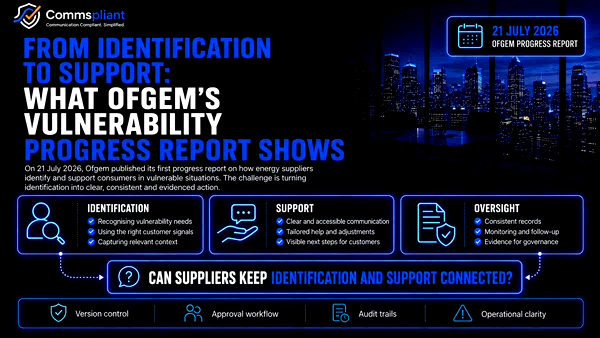
From Identification to Support: What Ofgem’s Vulnerability Progress Report Shows
Ofgem’s July 2026 progress report examines whether identifying customer vulnerability leads to clearer communication, timely support and better outcomes.
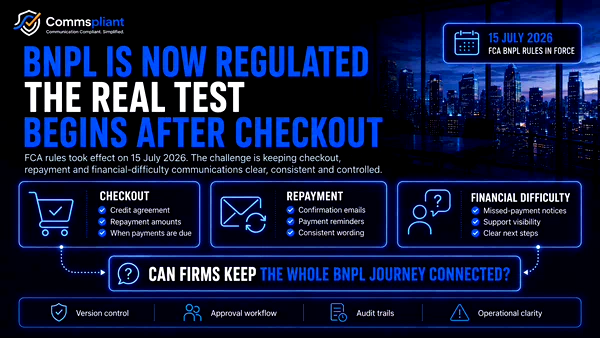
BNPL Is Now Regulated. The Real Test Begins After Checkout
BNPL regulation now reaches far beyond checkout. This practical overview explains the new UK rules, what changed, and why clear, connected customer communications matter throughout repayment and financial difficulty.
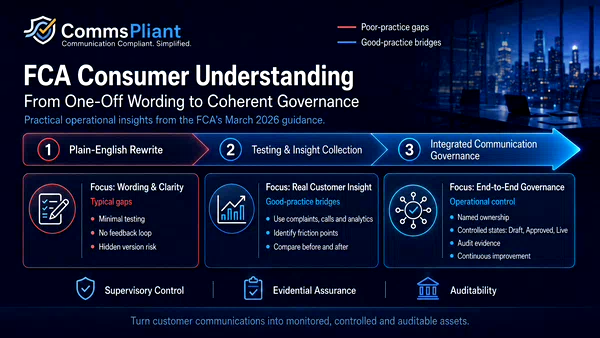
FCA Consumer Understanding: A Human Summary for Regulated Firms
A plain-English summary of the FCA’s March 2026 consumer understanding publication, with practical takeaways for regulated firms reviewing customer communications, testing, monitoring and governance.
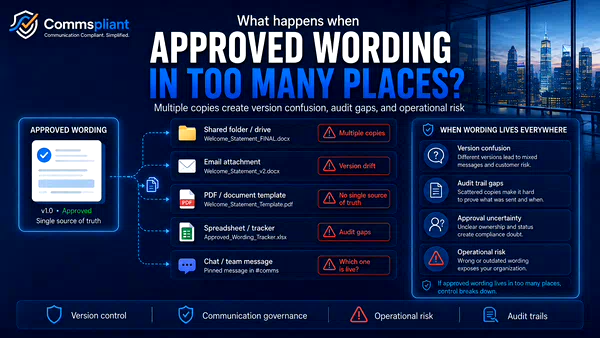
What Happens When Approved Wording Lives in Too Many Places?
Scattered approved wording across emails, PDFs, letters and internal tools can create version confusion and audit gaps. Learn why regulated teams need clearer communication control.
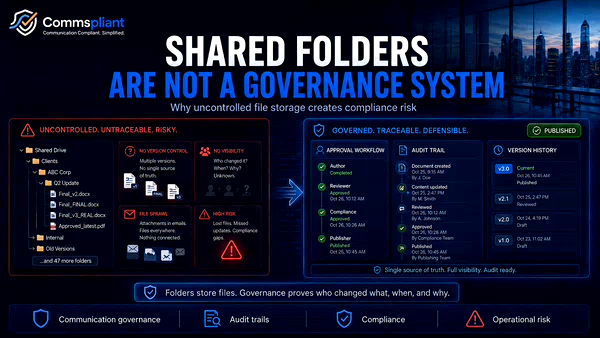
Shared Folders Are Not a Communication Governance System
Learn why shared folders are not enough for managing approved customer emails, PDFs and letters, and how they can create version confusion, approval gaps and audit trail problems.
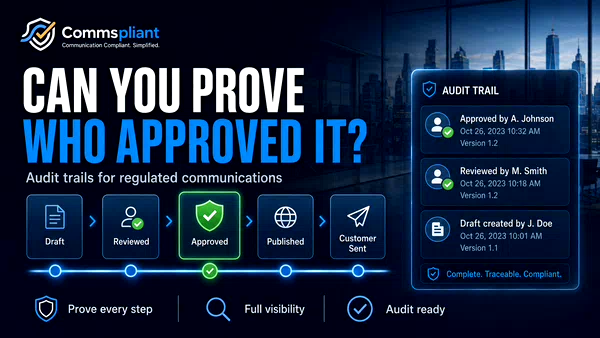
The Audit Trail Problem Hidden Inside Customer Email Templates
Customer email templates can hide audit trail gaps when wording, approvals and version history are scattered across tools. Learn why regulated teams need clearer control.
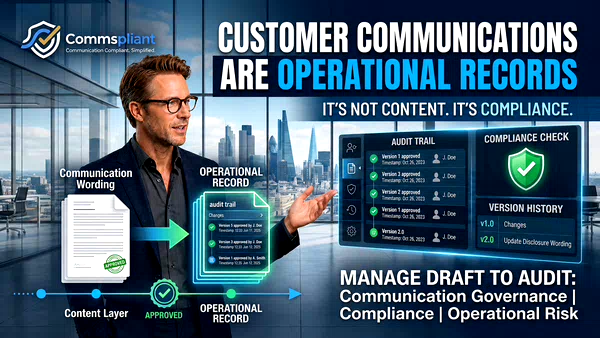
Customer Communications Are Operational Records, Not Just Content
Customer emails, PDFs and letters can become operational records in regulated businesses. Learn why approval workflows, version history and audit-ready records matter.
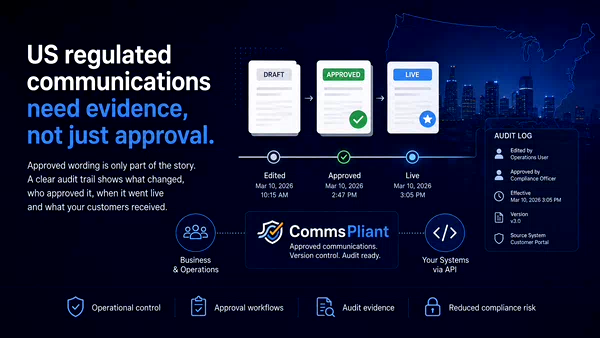
Why US Regulated Communications Need More Than Approved Wording
Customer emails, PDFs and disclosures in US regulated businesses need more than approved wording. Learn why approval history, version control and audit evidence matter.