
Illustrative case study: one possible approach to managing a wording change in a customer email about a tariff change.
A broadband provider is preparing an email about a tariff change. Customers need to understand what is changing, when it takes effect and where to find the details.
Commercial and Compliance have agreed the wording. The pricing data is already available to the email template. The remaining task is to update a short explanation.
But the wording sits inside the application code.
One paragraph, several handovers
Someone raises a developer ticket. It waits alongside other work. A developer updates the text, the change is checked, and the email template waits for the next software release.
The work involves more than editing a paragraph. People have to explain the request, coordinate the change and confirm that the released wording matches what was agreed.
The provider already knows what it wants to say. Its process still makes that wording dependent on an application release.
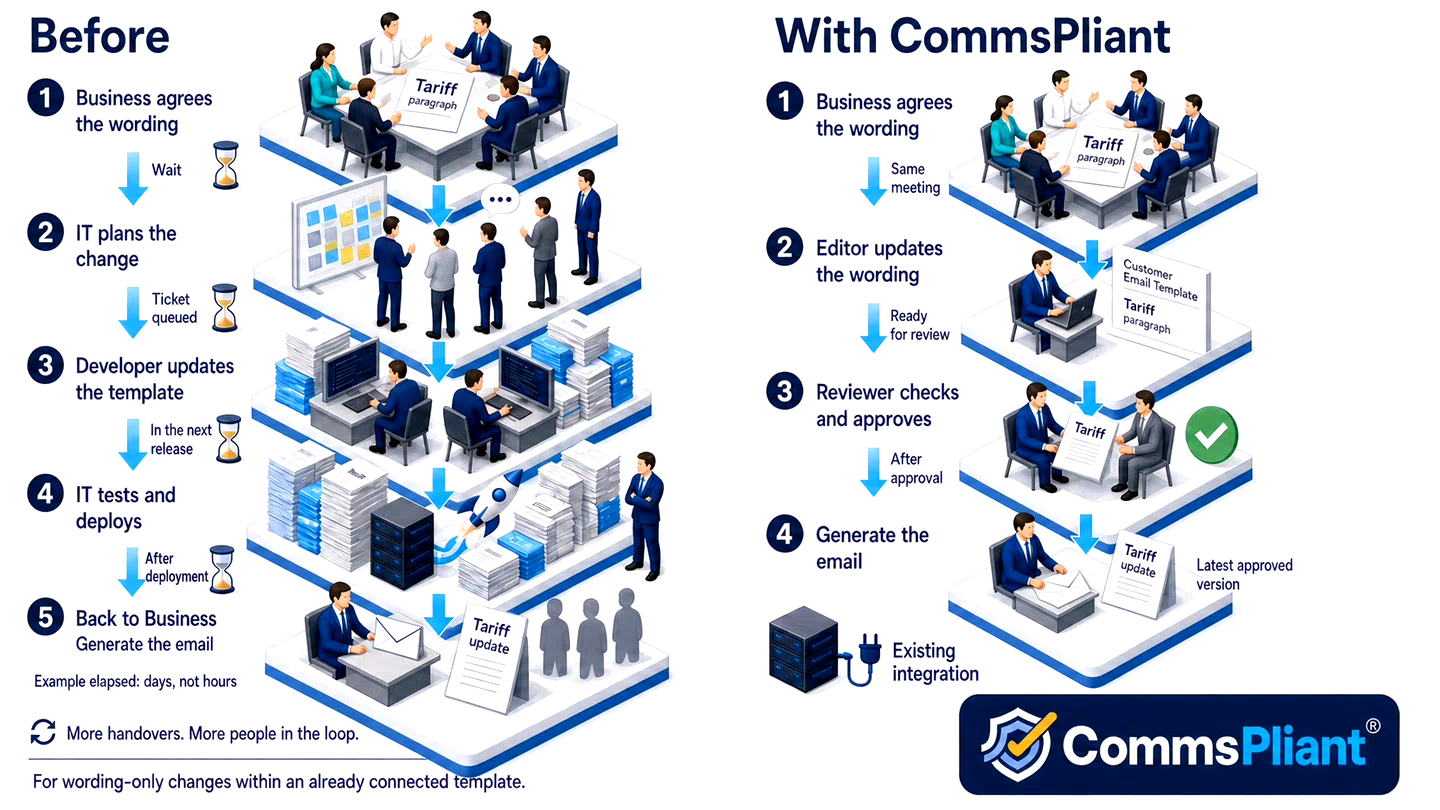
A workflow for customer communication templates
In this example, the provider has connected its existing systems to CommsPliant and set up the required permissions and approval workflow.
An authorised editor updates the tariff explanation in the customer email template. The change creates a new version, keeping the previous wording in the history.
The designated reviewers see the same proposed version. They can comment, request changes and approve it. The person who created or edited that version cannot approve their own work.
AI can assist with template wording; people review and approve the version to be used.
When the connected system next requests that template, CommsPliant generates the email using its latest approved version. For this supported wording change, there is no application code change to deploy.
The CommsPliant Evidence Vault connects the approval history to the generation record, so the provider can trace which approved version was used.
Engineering still handles changes to calculations, integrations or data requirements. Here, those capabilities already exist. The team is updating the explanation customers receive.
The provider still checks the tariff information and decides what customers should be told. Routine wording changes can move through the agreed controls with fewer handovers between teams.
If your next customer email needs one paragraph changed, can your team review and approve it without waiting for a software release?
For a closer look at which changes fit this approach, read When a Wording Change Should Not Wait for a Software Release.