

Customer Communications Governance vs CCM: Where Do Financial Promotions Fit?
Governance, CCM and financial promotion approval answer different questions. What each one checks, where they overlap, and what to ask of your setup.
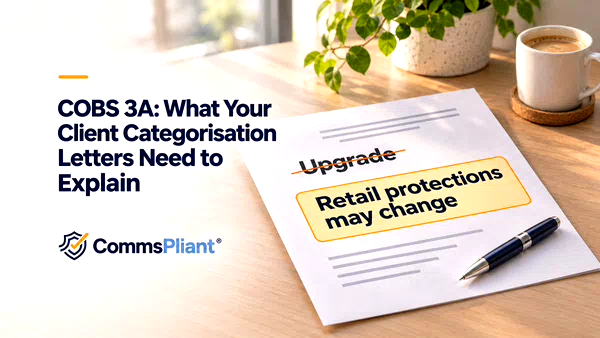
COBS 3A: What Your Client Categorisation Letters Need to Explain
COBS 3A changes how firms discuss professional status, warn clients and capture consent. What to review in your letters, consent journeys and client records.

The payment left on Monday. Where is it now? What the customer is told when an international transfer stalls
Why international payment updates can be unclear, what UK rules say about certain refusal notices, and how teams can manage the wording customers receive.

"We need a few more documents": what the customer is told during a KYC check
UK KYC and AML communications: how document requests and account-closure notices differ, and where tipping-off and approval questions arise.

Paying from the UK to Mexico: when the receiving bank asks for payer details
A Mexican bank may request more information about a UK payer. How to communicate a confirmed payment hold clearly and securely.

"Please send the invoice": when a provider holds a trade payment and asks for documents
Why a payment provider may request an invoice during a review, and how a clear document request can help customers respond.

One renewal, three answers: which one should the customer rely on?
When the renewal email, PDF and customer portal disagree, how can an insurance team verify the premium, cover and effective date before the next renewal run?

Pensions dashboards and member letters: which date does the figure refer to?
When dashboard and pension statement figures differ, clear labels matter. Practical checks for dates, value types and approved wording in member letters.

FCA information request deadlines: how to assemble the letter evidence pack
Responding to an FCA information request? Check which deadline applies and assemble a letter evidence pack linking approvals, generation, output and sending.

The customer is holding the letter. Can your agent see it?
When a customer calls about a letter, can your agent see the same document? A practical check of contact-centre access, guidance and communication records.
Regulation F validation notices: did you test the generated output?
Test generated Regulation F validation notices for long names, itemization fields and page breaks. Connect the reviewed output to the approved template version.
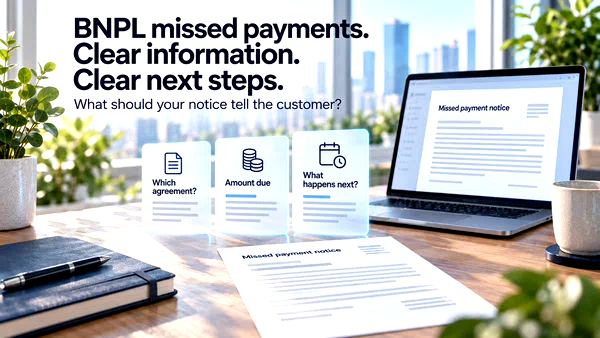
BNPL missed-payment notice: what CONC 7.20 requires
What FCA rule CONC 7.20.1R requires a missed-payment notice on regulated deferred payment credit to tell the customer, and how to check yours.
BNPL collections handover: what notice evidence should travel with the account?
What notice evidence should travel with a BNPL account? A practical checklist covering approved versions, generation records, retained outputs and sending results.
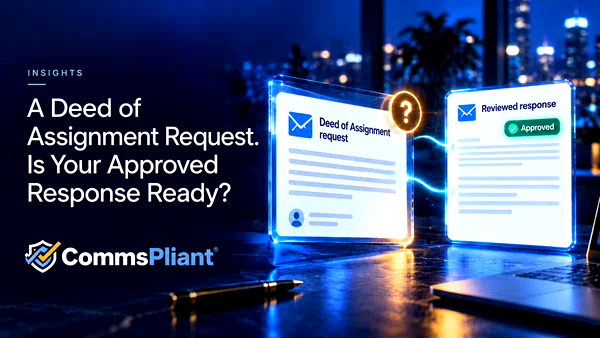
When a Customer Demands a Deed of Assignment: Is Your Approved Response Ready?
CSA guidance on Deed of Assignment myths, genuine subject access requests and keeping collections responses appropriate, approved and traceable.

AI writes the wording. Who approves it?
AI can improve customer wording. Learn how human approvals, template versions and generation evidence help teams control what is used.
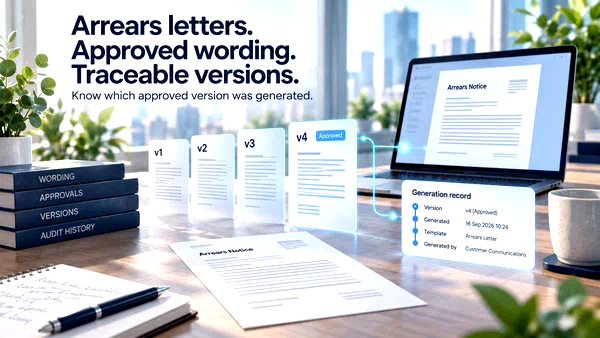
CONC 7 arrears communications: what rules apply, and which approved version was generated?
What CCA s86B–86C arrears notices and FCA CONC 7 require in arrears letters, plus a practical checklist for proving which letter version was generated.
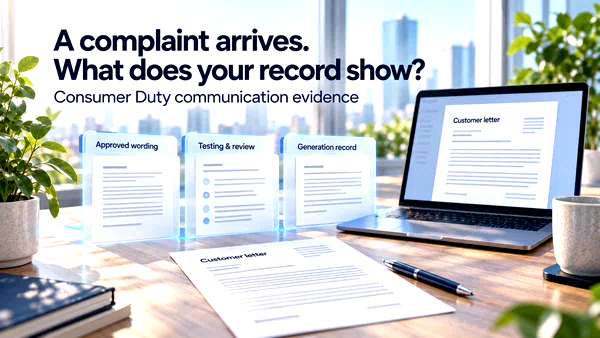
Consumer Duty communications evidence: what should your record show when a complaint arrives?
What the Consumer Duty and DISP expect when a complaint questions an arrears letter, what the FCA found in March 2026, and what your record should show.

One Customer Email, Three Teams, One Approval Workflow
See how three teams can review and approve one customer email during a broadband outage, with version history and a connected CommsPliant evidence record.
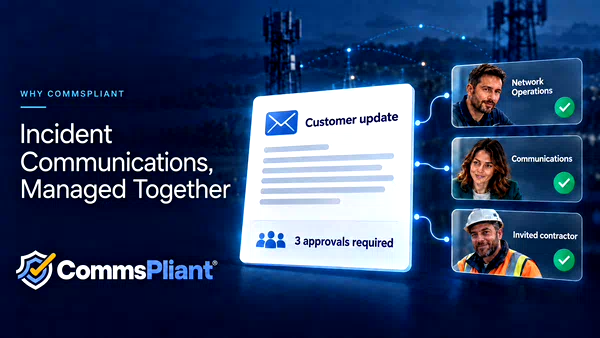
Incident Communications, Managed Together
Bring internal teams and external partners together to review and approve incident communications, with version history and the CommsPliant Evidence Vault.
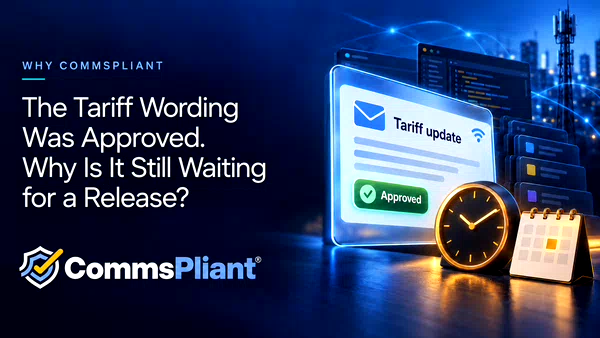
The Tariff Wording Was Approved. Why Is It Still Waiting for a Release?
Update tariff email wording through version control and human approval in CommsPliant, without a software release for supported template changes.
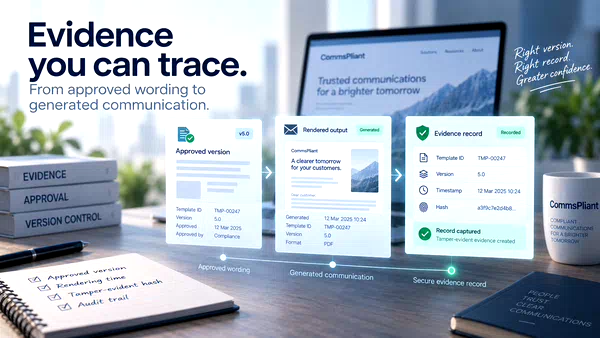
How to Evidence a Generated Customer Communication
Learn what evidence can connect a generated customer communication to its approved template version, rendering event and audit history.

When the Real Compliance Problem Is Proving Who Changed What
When approvals are questioned later, can you prove who changed, reviewed and approved the exact version? Explore the communication evidence problem.

When One Mobile Mast Fails: What Ofcom’s Proposed Incident-Reporting Changes Could Mean
Ofcom is proposing new mobile and rural telecoms incident-reporting thresholds. See what providers should understand and prepare for.

When the Evidence Disappears, Oversight Disappears With It
An FCA pension transfer case shows why effective oversight depends on aligned permissions, protected records and evidence that can be reconstructed.

Which Version Did the Customer See?
When approved wording reaches email, portal and PDF at different times, customers can see different versions. See how CommsPliant helps keep them aligned.
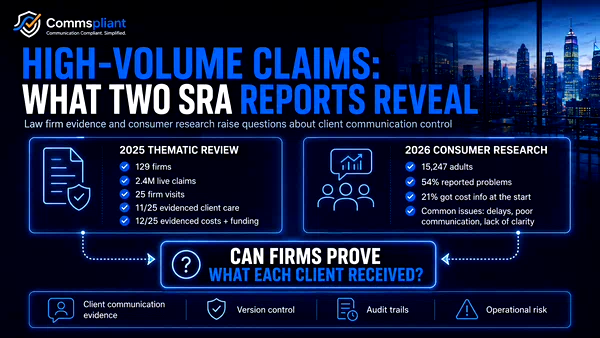
High-Volume Consumer Claims: What Two SRA Reports Reveal About Client Communication Evidence
A practical overview of two SRA reports on high-volume consumer claims, what they found about law firm practices and consumer experiences, and why firms need reliable evidence of what each client received.

When a Customer Complaint Becomes an Audit of Your Communication Controls
A customer complaint can expose gaps in versioning, approvals and audit evidence. Explore what regulated teams need to reconstruct what was sent.

SEC's New Accounting Enforcement Unit: The Evidence Question Beyond Approved Wording
The SEC has launched a new accounting enforcement unit. We explore the separate evidence question: can firms prove what was approved and communicated?

SEC proposes default e-delivery: why digital communications still need control and evidence
The SEC has proposed default electronic delivery for certain regulatory information. We examine what it could mean for communication control, delivery and audit evidence.
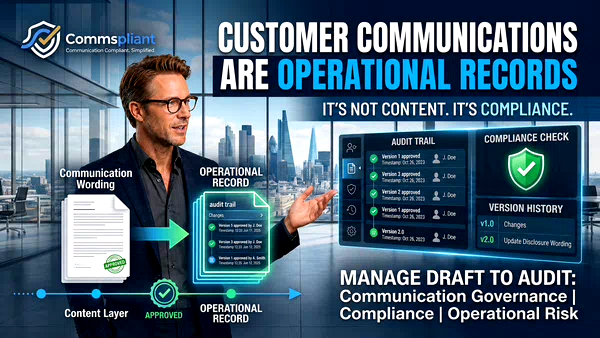
Customer Communications Are Operational Records, Not Just Content
Customer emails, PDFs and letters can become operational records in regulated businesses. Learn why approval workflows, version history and audit-ready records matter.