
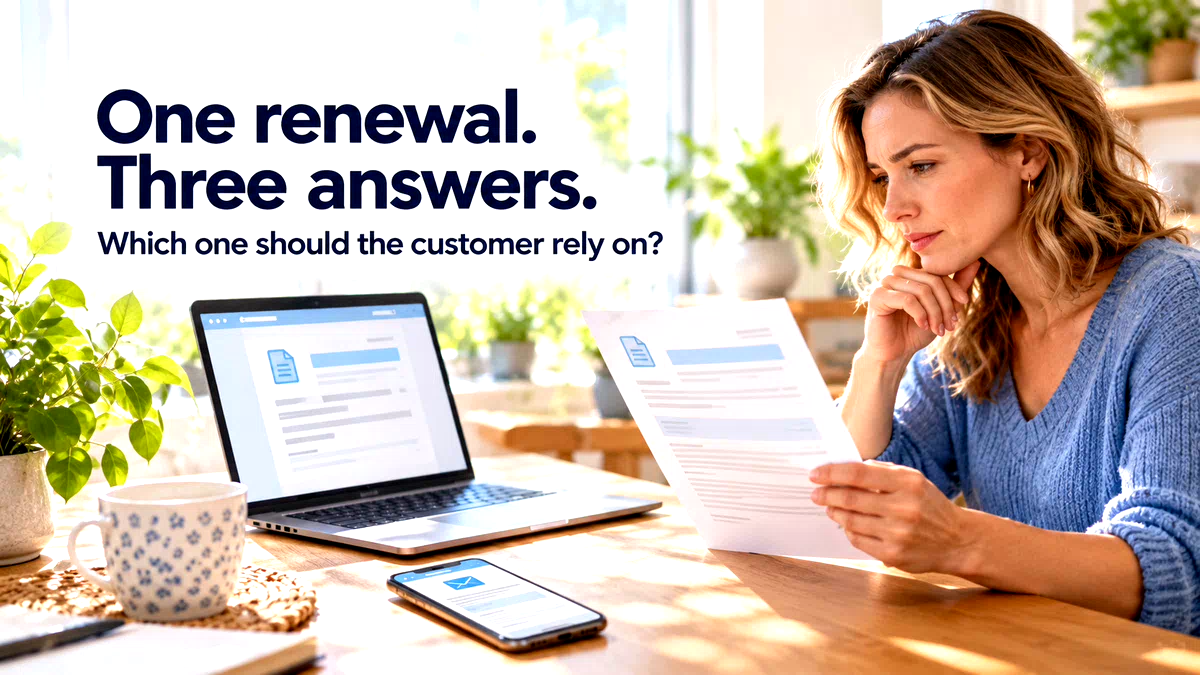
The renewal email says the premium will rise by 12% because the policy will cover more. The customer opens the attached PDF to see what the extra premium buys. It describes the same cover they had last year. They sign in to the portal, where the renewal summary quotes a different premium and a later start date.
They reply to the email. “Which one should I rely on?”
In this illustrative case, the service team checks the policy record. The premium, cover and effective date in the email are correct. When the team compares the three explanations, it finds last year’s cover description in the PDF template. The portal summary still quotes the price and date from an earlier renewal offer.
The team can now answer the customer’s question. It can also explain how one renewal produced three answers even though the policy record was correct.
What needs to match across channels?
An email might summarise the change in a sentence. The PDF has room to describe the cover in detail. The portal might put the premium and start date at the top, with a link to the full terms. Each channel can use its own template. A customer reading them side by side should still understand what they will pay, what cover they will get and when the change takes effect.
In the UK, ICOBS 6.5 sets out what a renewal notice must include when a firm proposes to renew a consumer’s general insurance policy (excluding group policies and contracts shorter than 10 months). Among other things, the notice must show this year’s premium and last year’s premium. Our reading: when one renewal is explained in three places, the team should know which one it treats as the renewal notice, and check that the other two do not contradict it.
What to check before the next renewal run
- Start with one renewal. Confirm the premium, cover and effective date against the policy record. Find the explanation approved for that product and date.
- Read all three together. Open the email, its PDF attachment and the portal preview for the same renewal. Does each one reflect the confirmed details? Can the customer find the cover change that explains the higher premium?
- Check packs already prepared. If the explanation changed after the PDFs were generated, identify which packs still contain the earlier wording and which need to be generated again.
- Try answering a later query. Choose a previous renewal. Can a handler identify the template version used for that customer’s PDF, even if the template has since changed?
CommsPliant links each document generated through the platform to the approved template version used and its approval history. Where the generation record identifies the channel, the team can see which wording was used for that channel and when it was generated. The policy system remains the source for the premium. Sending, delivery and publication in a portal each require separate evidence.
For the next renewal run, put one email, its attachment and the matching portal preview in front of a colleague. Ask them what changes, how much it costs and when it starts. If their answer depends on which one they read, you have a specific discrepancy to resolve before the pack goes out.