
Customer Communications Governance vs CCM: Where Do Financial Promotions Fit?
Governance, CCM and financial promotion approval answer different questions. What each one checks, where they overlap, and what to ask of your setup.

What a US Commercial Invoice Can Teach Us About Template Version Control
Two warehouses, two copies of one invoice template. What 19 CFR 141.86 asks of a US commercial invoice, and what template drift teaches teams that generate regulated customer documents.

The file moves. Does the flag? What CONC 7.13 says should travel with a debt
When a debt passes to a collector, do the dispute and vulnerability flags go with it? What CONC 7.13 and 7.14 say, and where the flag gets lost.

One missing paragraph: the final response that doesn’t start the six-month clock
Does a final response explain the six-month ombudsman time limit? What DISP 1.6 and DISP 2.8 say about when the clock starts, and what to check in the wording.

Dated Monday. Posted Friday. The date that starts the debtor’s 30 days
A Letter of Claim dated Monday, posted Friday. How the Pre-Action Protocol for Debt Claims counts the 30 days, and the three dates worth comparing.

The debt adviser just called: what CONC 7.3.11R suspends, and for how long
A debt adviser calls to say a repayment plan is on its way. What CONC 7.3.11R suspends, how long the pause lasts, and where it breaks.

Nothing is late. Yet. When CONC 7.3 forbearance starts before arrears
A customer who has never missed a payment says next month will be hard. Why CONC 7.3 already applies, and where the early signal gets missed.

Same letter, two legal systems: old debts in England and Scotland
The same arrears template, sent to Leeds and Glasgow. Why an old debt is treated differently in England and Scotland, and what CONC 7.8 and 7.15 say.

Breathing Space has two clocks: what stops in your letter sequence
A Breathing Space notice arrives with a reminder due tomorrow. What creditors must stop, which letters may still go, and why the two types end differently.

Who else reads the envelope?
What CONC 7.9 says about third parties learning of a debt. Practical checks for the sender name, envelope and the records that show what was sent.

Which parts of a customer letter should AI be allowed to rewrite?
AI can make complaint letters clearer. Decide which wording it may rewrite, which facts must retain their meaning, and which text needs protection.

The template owner leaves. Who takes over?
When a letter template owner leaves, use this handover checklist to assign the next editor, flag unfinished drafts and pass on review dates.

One renewal, three answers: which one should the customer rely on?
When the renewal email, PDF and customer portal disagree, how can an insurance team verify the premium, cover and effective date before the next renewal run?

Pensions dashboards and member letters: which date does the figure refer to?
When dashboard and pension statement figures differ, clear labels matter. Practical checks for dates, value types and approved wording in member letters.

Forbearance letter wording: can the customer understand the support offered?
Review forbearance letters against the support offered. Check payment terms, balance and credit-file explanations, and keep creditor and agency wording aligned.
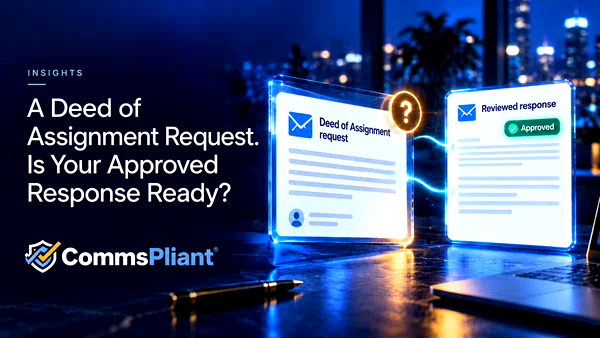
When a Customer Demands a Deed of Assignment: Is Your Approved Response Ready?
CSA guidance on Deed of Assignment myths, genuine subject access requests and keeping collections responses appropriate, approved and traceable.

AI writes the wording. Who approves it?
AI can improve customer wording. Learn how human approvals, template versions and generation evidence help teams control what is used.

One Customer Email, Three Teams, One Approval Workflow
See how three teams can review and approve one customer email during a broadband outage, with version history and a connected CommsPliant evidence record.

Incident Communications, Managed Together
Bring internal teams and external partners together to review and approve incident communications, with version history and the CommsPliant Evidence Vault.

When the Real Compliance Problem Is Proving Who Changed What
When approvals are questioned later, can you prove who changed, reviewed and approved the exact version? Explore the communication evidence problem.

When Systems Fail, Who Approves the Customer Update?
The FCA’s resilience exercise raises a practical question: can your team prepare, approve and track customer updates when disruption affects several firms?

The FCC's New Submarine Cable Security Regime: What Changes on 25 September—and What Comes Later
The FCC's submarine cable security order has a September 2026 general effective date, but many operational requirements remain delayed indefinitely. Here's what takes effect and what remains pending.

When the Evidence Disappears, Oversight Disappears With It
An FCA pension transfer case shows why effective oversight depends on aligned permissions, protected records and evidence that can be reconstructed.

One Name on the Approval Log
One name on an approval log doesn't prove independent review. Learn why segregation of duties matters and how to enforce it as a workflow rule.
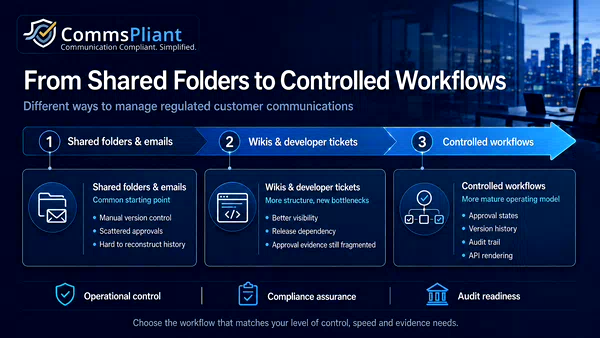
Different Ways to Manage Regulated Customer Communications: From Shared Folders to Controlled Workflows
Shared folders, wikis, developer tickets or a controlled workflow: compare four ways regulated teams manage customer emails, PDFs and letters.

Senior FCA Official Urges Financial Firms to Use ECCTA Information-Sharing Powers
A senior FCA official is urging financial firms to use ECCTA information-sharing powers as government guidance highlights audit trails and decision records.

Off-the-Shelf Controls Aren't Enough: The Operational Lesson Behind the FCA's Annex 1 Warning
The FCA is increasing scrutiny of Annex 1 firms. We look at the operational lesson for regulated communications, governance and audit-ready evidence.
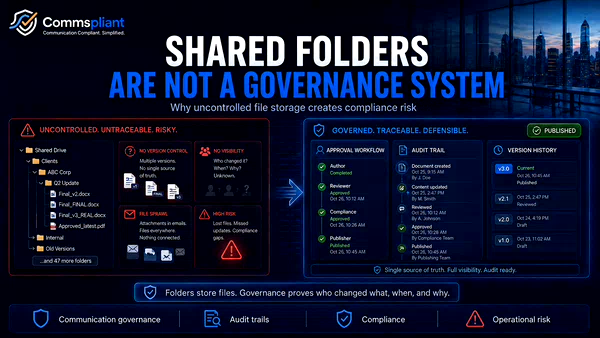
Shared Folders Are Not a Communication Governance System
Learn why shared folders are not enough for managing approved customer emails, PDFs and letters, and how they can create version confusion, approval gaps and audit trail problems.
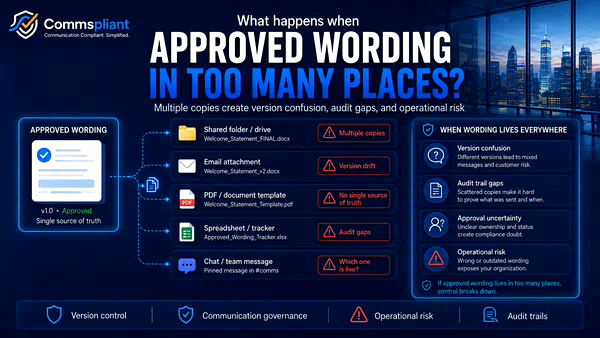
What Happens When Approved Wording Lives in Too Many Places?
Scattered approved wording across emails, PDFs, letters and internal tools can create version confusion and audit gaps. Learn why regulated teams need clearer communication control.
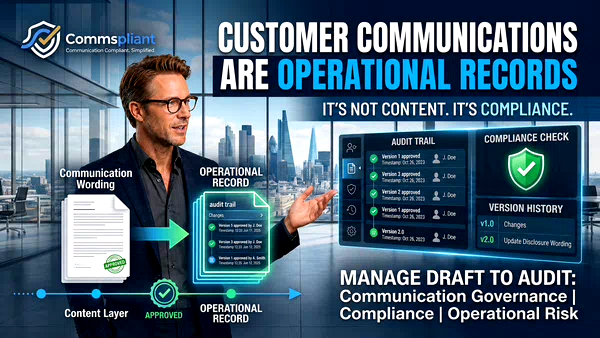
Customer Communications Are Operational Records, Not Just Content
Customer emails, PDFs and letters can become operational records in regulated businesses. Learn why approval workflows, version history and audit-ready records matter.
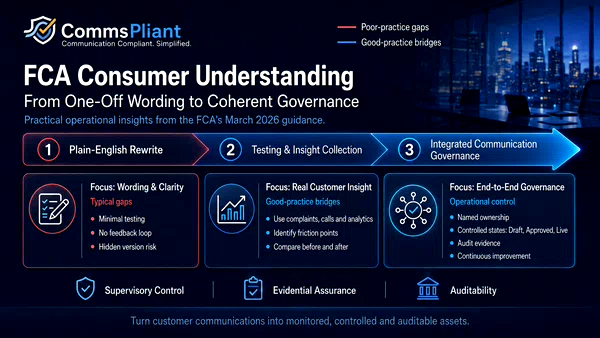
FCA Consumer Understanding: A Human Summary for Regulated Firms
A plain-English summary of the FCA’s March 2026 consumer understanding publication, with practical takeaways for regulated firms reviewing customer communications, testing, monitoring and governance.