
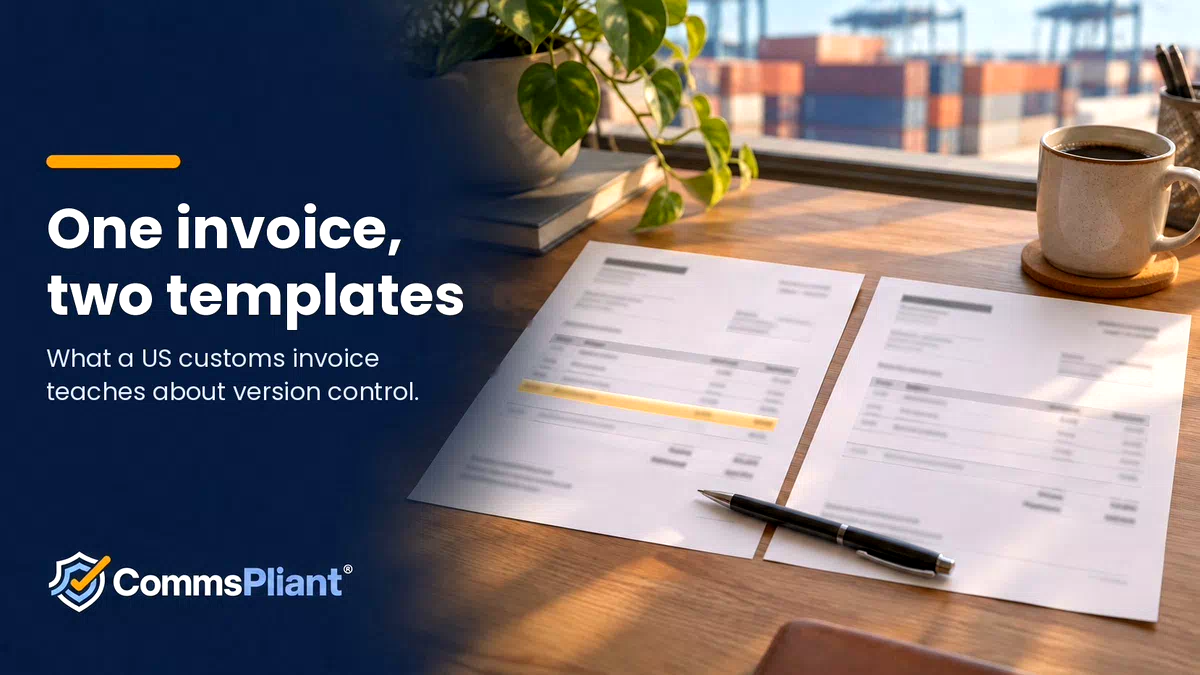
Illustrative example. An exporter ships similar goods to the United States from two warehouses. Both print commercial invoices from the same system, but each site has its own copy of the template. In both cases, packing is included in the invoice price. Last spring, one site updated its template to say so. The other did not. A customs broker asks the exporter to clarify how packing has been accounted for.
Nobody changed the rules. Somebody changed a template, once, in one place.
What the invoice must show
For goods entering the United States, a commercial invoice must be filed for each shipment unless an exemption applies. It must be prepared "in the manner customary in the trade" and contain the information required by 19 CFR 141.86 to 141.89 (19 CFR 141.83(c)(1)).
Section 141.86(a) contains eleven numbered categories of general information. Some apply only to purchased goods, others to goods not purchased. The examples below are not a complete checklist; other paragraphs and related rules may also apply. They include:
- the port of entry the goods are destined for;
- the time, place and parties to the sale;
- a detailed description of the goods, with marks and numbers;
- quantities, and the purchase price of each item in the currency of purchase;
- all charges itemized by name and amount, such as freight, insurance, commission, containers and packing. Packing, cases, containers and inland freight to the port of exportation need not be itemized by amount if included in the invoice price, "and so identified";
- rebates, drawbacks and bounties allowed on exportation, itemized separately;
- the country of origin;
- assists: goods or services furnished for production and not included in the invoice price, excluding those furnished in the United States.
Where required information does not appear on the invoice as first prepared, it must be shown on an attachment. The invoice and all attachments must be in English or come with an accurate English translation (141.86(d)), and the invoice must state in adequate detail what is in each package (141.86(e)).
A US pro forma invoice under 19 CFR 141.85 is a specific document: an importer's statement of value or price, used when the importer does not hold the seller's or shipper's invoice. It is not the same as a supplier's pro forma sent to request an advance payment. For some merchandise, section 141.83(d) does not require a commercial invoice but other documents or a pro forma may be needed. Where a required commercial invoice is unavailable, separate conditions and possible waivers apply, so a pro forma is not an automatic replacement in every case.
Why the template is where it goes wrong
Missing information can result from an outdated template, incomplete source data or a problem in the document-generation workflow. Version control helps teams see which template was used, but the underlying data and any required attachments still need to be checked. Our reading of where templates slip, rather than anything the regulations say:
- Copies multiply. Each site, entity or system keeps its own version, and changes reach some copies and not others.
- Fields are optional in the system. Country of origin or itemized charges can be left blank without anyone noticing.
- Nobody owns the wording. Logistics edits the layout, finance edits the charges, and no one signs off the whole.
- There is no history. When a broker queries an old entry, nobody can say which version of the template produced that invoice.
The same problem, in customer communications
The customs invoice is a useful mirror. It is a document generated from a template, and it has required content set by rules. When it goes wrong, the cause is often a template or data change, not bad intentions.
The same version-control question appears in customer communications. Some regulated letters and notices need specific information, and many teams generate them from templates. CommsPliant helps teams manage approved customer-communication templates, their versions and approval history. It does not issue customs invoices.
Questions worth asking about your own templates
- How many copies of each template exist, and which one is current?
- Are required fields enforced, or can they be left blank?
- Who signs off a change to a template, as a whole?
- Could you say which version produced a document from six months ago, and do your generation and retention records let you link the two?