
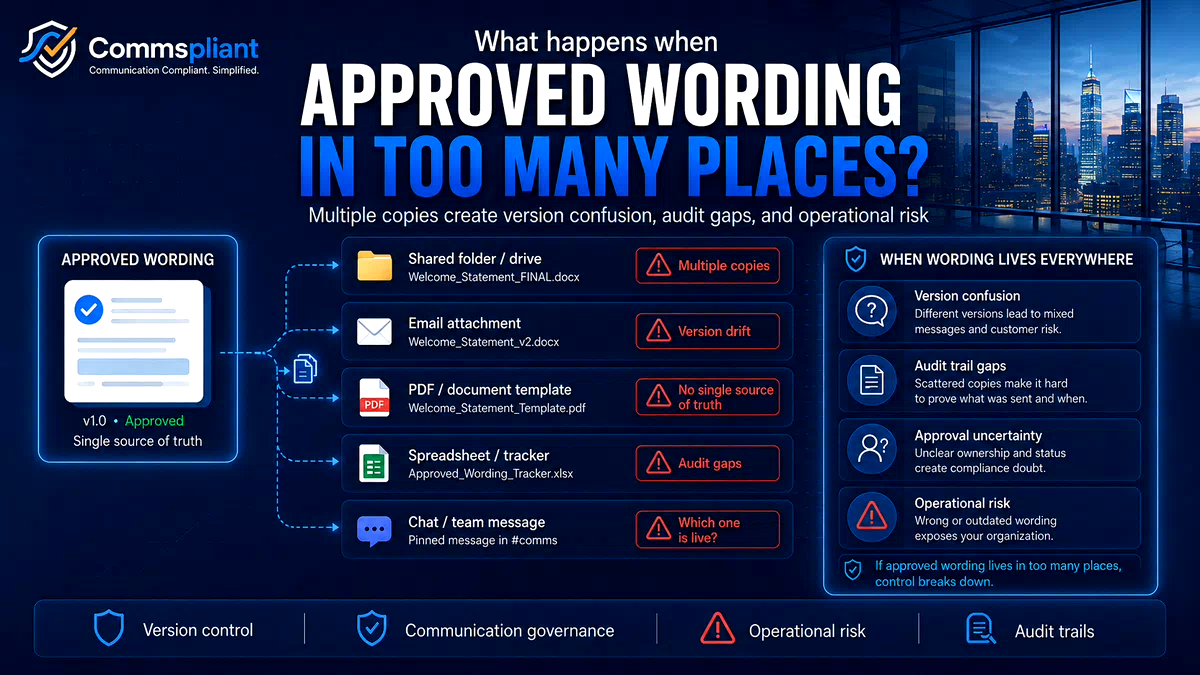

When a regulated business launches a new product or service, its approved customer-facing wording is usually easy to manage.
The core explanations, notices, terms, disclosures or customer instructions may exist in only a few places.
But as the business grows, that wording begins to spread.
The same fee explanation, pension rule, product notice or approved disclaimer might appear in an automated onboarding email, a generated PDF, a customer letter, a website screen, an internal operations document and an application template.
At first, this can feel practical.
The wording is available where teams need it.
But when a rule changes, a product update is approved or a wording correction is needed, the business may discover that the same approved text now lives in too many disconnected places.
That is where fragmentation becomes a problem.
The Illusion of a Simple Correction
A wording update can look simple from the outside.
One sentence changes. One paragraph needs replacing. One approved explanation needs updating.
But in practice, the business may need to answer several operational questions:
Do we know every system, template and document where this wording currently appears?
Are automated emails and PDF outputs using the same approved version?
Has the old wording been removed or retired from relevant templates?
Are any legacy systems still using an outdated version?
Can we prove when the new wording was approved and when it became live?
Can we show which version a customer received at a specific point in time?
Without a controlled process, answering these questions can require manual investigation across teams and systems.
Why Wording Fragmentation Happens
Wording fragmentation is rarely caused by poor organisation.
It usually happens because growing businesses add tools, templates and processes over time.
Each new channel needs customer-facing wording.
Each team solves the immediate problem in the system they use.
Over time, the wording begins to spread.
The copy-and-paste problem
A product or operations team needs approved wording for a new customer email, PDF or notification.
Because there is no controlled source to pull from, someone copies the wording from an old email, internal document or previous template.
The new template goes live.
But the wording is now duplicated, and its connection to the original approval record may be unclear.
The silent variation problem
When the same wording is managed independently in different places, small differences can appear.
A sentence may be shortened to fit a layout.
A punctuation change may be made inside a code string.
A paragraph may be adjusted in a PDF template.
A product manager may update wording in one document but not another.
Each change may feel small.
But over time, the business can end up with several slightly different versions of what should be the same approved wording.
The hidden repository problem
Important customer communication wording can end up in places compliance and operations teams do not easily monitor.
It may sit inside application code, legacy systems, database fields, third-party tools, local files, old PDF templates or archived spreadsheets.
The business may believe it has updated the wording everywhere, while an older version remains active in a less visible system.
The missed asset problem
When a rule or policy changes, teams may update the main templates they know about.
But they may miss a low-frequency communication, such as an annual statement, complaint response, renewal notice or exception letter.
That outdated wording may remain live until a customer complaint, audit question or internal review reveals the gap.
The Cost of Scattered Wording
When approved wording is scattered, the cost is not only the time spent updating text.
The bigger cost is uncertainty.
Teams may need to investigate which wording was used, where it appeared, when it changed and whether customers received the correct version.
That investigation can involve compliance, operations, product, data and engineering teams.
Instead of having a clear communication record, the business has to reconstruct the history manually.
This slows the organisation down and increases operational risk.
What Better Wording Governance Looks Like
A stronger approach gives approved customer-facing wording a controlled home.
The goal is not to stop teams from collaborating.
The goal is to reduce scattered copies, unclear ownership and disconnected approval records.
A better communication governance process should include:
1. One controlled workspace
Approved customer communication wording should live in a structured environment where teams can manage draft, review, approval, publication and retirement.
2. Clear ownership
Teams should know who can draft, who can review, who can approve and who can publish each type of communication wording.
3. Controlled reuse
If the same wording is used across multiple emails, PDFs or letters, teams should be able to reuse it through a controlled process rather than copying and pasting it manually.
4. Version history
Every approved version should have a clear record of what changed, when it changed and who approved it.
5. Easier evidence
If the business needs to prove what was live at a specific point in time, the record should be easier to find without searching through folders, tickets, email chains and code repositories.
Separating the Wording Source from the Delivery System
One useful shift is to separate approved communication wording from the systems that deliver it.
The application should manage the customer journey, data flow, security, delivery logic and system performance.
The communication workspace should manage the wording, approval workflow, version history and audit record.
This creates a cleaner division of responsibility.
Engineering remains responsible for the technical foundation.
Compliance and operations gain clearer control over approved wording.
Product teams gain better visibility over what is live.
The business gains a more reliable way to manage communication change.
Where CommsPliant Fits
CommsPliant is a working platform that helps regulated teams manage approved customer emails and PDFs in one controlled workspace, with approval workflows, version history, audit logs and API rendering.
The goal is to reduce wording fragmentation by giving teams a clearer way to manage, approve, reuse and evidence customer communication wording.
Instead of relying on scattered spreadsheets, shared folders, developer tickets, email chains and code history, teams can manage the communication lifecycle through one structured process.
General Information Notice
This article is for general information only and does not constitute legal, regulatory or compliance advice. Regulated firms should consult qualified compliance or legal professionals when interpreting specific obligations.
Book a discovery call
CommsPliant is a working platform for regulated businesses that manage customer emails, PDFs or letters through fragmented workflows and want a clearer, more auditable way to control communication changes.
If your team is trying to reduce wording confusion, manual approvals or developer dependency in customer communication workflows, book a discovery call or contact us to discuss CommsPliant.