
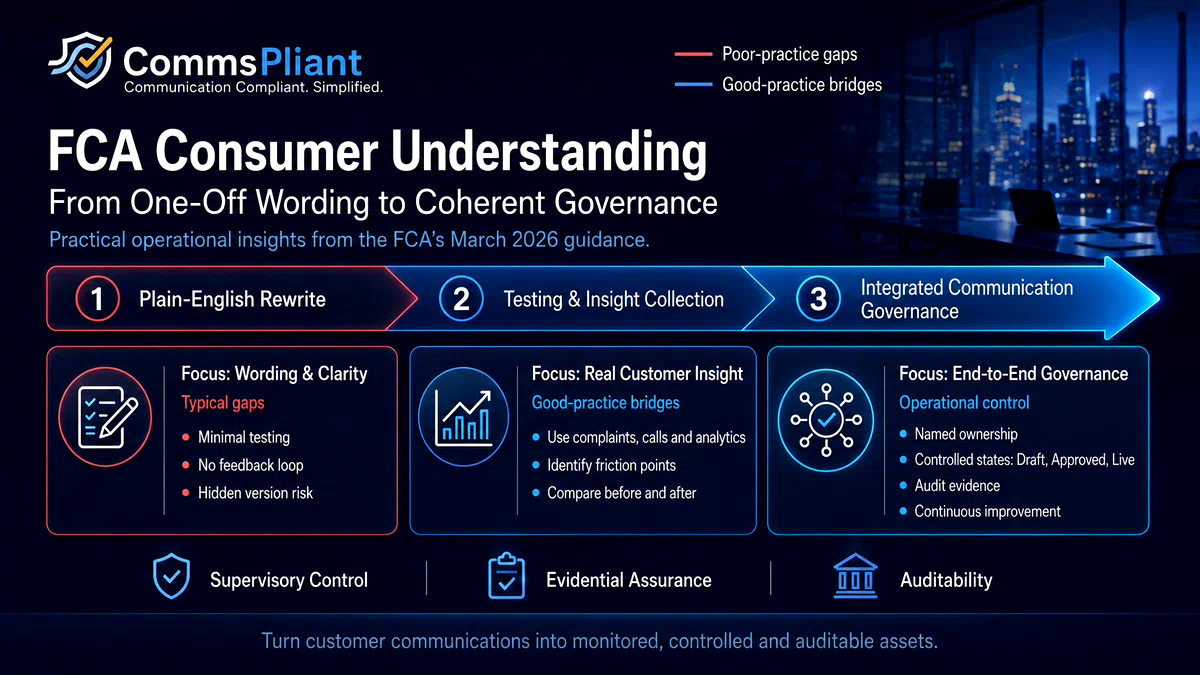

Why the FCA’s consumer understanding publication matters
In March 2026, the FCA published examples of good practice and areas for improvement on consumer understanding under the Consumer Duty.
The message is practical: firms should not treat customer communications as a one-off wording exercise.
It is not enough to write something clearly, approve it once, and leave it in a folder.
The FCA’s publication points to a fuller process. Firms should think about how communications are designed, tested, monitored, improved and governed over time.
In simple terms, the question is not only:
“Did we write this clearly?”
The better question is:
“Do we know whether customers understood it, and can we show what we did when they did not?”
That is the important shift.
Consumer understanding is not only about the words on the page. It is also about the process behind the words.
Consumer understanding is not just plain English
Plain English matters. Shorter sentences, clear headings and less jargon can all help customers.
But the FCA’s examples show that consumer understanding goes further than rewriting text.
A communication may be written in simple language and still fail if:
customers do not see the most important information at the right time;
risks are technically included but not prominent;
the layout makes key points hard to find;
the firm does not test whether customers understand the message;
the same communication does not work well for vulnerable customers;
customer feedback is collected but not used;
there is no clear record of why changes were made.
So, the real issue is not only language.
It is evidence, testing and governance.
The FCA wants firms to use insight, not assumptions
One of the strongest themes in the FCA publication is the use of insight.
Good practice means looking at real signals from customers, not guessing from inside a meeting room.
Useful sources of insight may include:
customer calls;
complaints;
chat transcripts;
website analytics;
drop-off points in online journeys;
customer surveys;
frontline staff feedback;
post-sale understanding checks.
The important point is not collecting data for decoration.
The firm should be able to explain what the information showed, what action was taken, and whether the change helped.
For example, if many customers call after receiving the same letter, that may be a sign that the letter is unclear. If customers abandon an online journey at the same step, that may show confusion or poor timing of information.
The useful question is:
“What are customers showing us through their behaviour?”
Testing should happen before and after changes
The FCA highlights that testing can be proportionate. Smaller firms do not need huge research teams or expensive systems.
Testing might be as simple as:
asking a small group of customers to explain the message back in their own words;
running a short survey after sending a revised letter;
checking whether customers understand key costs, risks or next steps;
comparing outcomes before and after a wording or layout change;
asking frontline staff what customers repeatedly misunderstand.
The key is to avoid superficial testing.
A tick-box review that says “communication checked” is weaker than evidence showing what was tested, what customers struggled with, what changed and whether the revised version improved understanding.
A practical record might include:
what communication was tested;
who it was tested with;
what customers misunderstood;
what changes were made;
who approved the changes;
what happened after the revised version went live.
That is where testing becomes useful governance, not just a compliance ritual.
Good design is about helping customers find what matters
The FCA also talks about communication design.
This does not only mean making something look modern or attractive. It means helping customers notice, understand and act on important information.
Good design may include:
clear headings;
short summaries;
important information placed early;
risks and limitations given proper prominence;
layered content, so customers are not overwhelmed;
accessible formats;
stronger signposting;
mobile-friendly layouts;
simple explanations for complex topics.
The FCA also warns against cosmetic changes.
Changing colours, adding icons or shortening text does not automatically improve understanding.
A firm needs to ask:
“Did this design change actually help customers understand better?”
If the answer is unknown, the firm may need better testing or monitoring.
Accessibility and vulnerability should be part of the process
The publication also reminds firms to consider different customer needs.
Some customers may have lower financial confidence. Some may have accessibility needs. Some may be in vulnerable circumstances. Some may struggle with digital journeys, long documents or complex financial language.
A communication that works for one group may not work for another.
Good practice means thinking about this early, not after a problem appears.
Firms can review whether they:
test communications with different types of customers;
offer accessible formats;
avoid relying only on digital routes;
make important information easy to find;
train staff to spot signs of confusion;
review whether vulnerable customers experience different outcomes.
This is not about making every communication perfect for every person.
It is about being able to show that the firm considered foreseeable barriers and took reasonable, proportionate steps.
Financial promotions need balance, not just approval
The FCA also discusses financial promotions.
A promotion should not make benefits loud and risks quiet.
Good practice includes making sure customers can understand:
what is being offered;
who is eligible;
what the main limitations are;
what the risks are;
what costs or conditions apply;
what action the customer needs to take.
The FCA’s examples suggest that firms should not rely only on internal approval. They should also consider whether customers actually understand the promotion.
A promotion may pass a technical compliance review but still confuse customers if the layout, timing or emphasis is poor.
This is especially important across mobile, email, web pages and social media, where information can be resized, shortened or separated from its original context.
Governance is the thread running through the whole publication
The strongest practical lesson is governance.
The FCA is not only asking firms to communicate clearly. It is asking firms to manage consumer understanding as an ongoing outcome.
That means someone should be responsible. Decisions should be recorded. Management information should be reviewed. Actions should be tracked. Changes should be followed up.
For smaller firms, this does not need to mean complicated committees.
It may be enough to have:
a named person responsible;
a simple communication review log;
clear notes of decisions;
records of customer feedback;
evidence of what was changed and why;
regular checks that changes worked;
a way for staff to raise confusing communications.
The important thing is that the process is real, repeatable and visible.
Practical questions firms can ask themselves
A regulated firm reviewing this publication could start with a simple self-check.
For each important customer communication, ask:
Do we know who owns this communication?
Do we know where the current live version is?
Do we know when it was last reviewed?
Do we know who approved it?
Do we know what customer insight informed it?
Do we know whether it was tested?
Do we know whether different customer groups understand it?
Do we monitor complaints, calls or drop-off linked to it?
Do we have a record of what changed and why?
Can we prove which version was live at a particular time?
If these questions are difficult to answer, the issue may not be the wording alone.
The issue may be the communication control process around the wording.
Simple improvement ideas
Firms do not need to fix everything at once.
A practical starting point could be:
choose the five most important customer communications;
check where the live versions are stored;
review whether the most important information is easy to find;
look at complaints, calls or customer questions linked to those communications;
test one communication with a small group of customers or staff;
record what customers misunderstood;
update the wording, layout or timing;
keep a simple note of what changed, why it changed and who approved it;
check again later to see whether the problem improved.
This kind of small, repeatable process is more valuable than a large policy document that nobody uses.
Where CommsPliant connects to this topic
This is the kind of operational problem CommsPliant is being designed to support.
Not by deciding what a firm’s regulatory obligations are, and not by replacing legal or compliance judgement.
The connection is more practical.
Regulated teams often need a clearer way to manage approved customer emails, PDFs and letters, including version history, approval workflows and audit evidence.
Because consumer understanding is not only about the final words the customer sees.
It is also about whether the firm can show how those words were reviewed, tested, approved, changed and controlled over time.
Final thought
The FCA’s publication is a useful reminder that customer communications are not just documents.
They are part of the customer journey.
They shape decisions. They explain risks. They tell people what to do next.
So the real question for regulated firms is not only:
“Is this clear?”
It is:
“Do we have a process that helps us know it is clear, keep it clear, and prove what we did?”
That is where consumer understanding becomes more than plain English.
It becomes governance.