
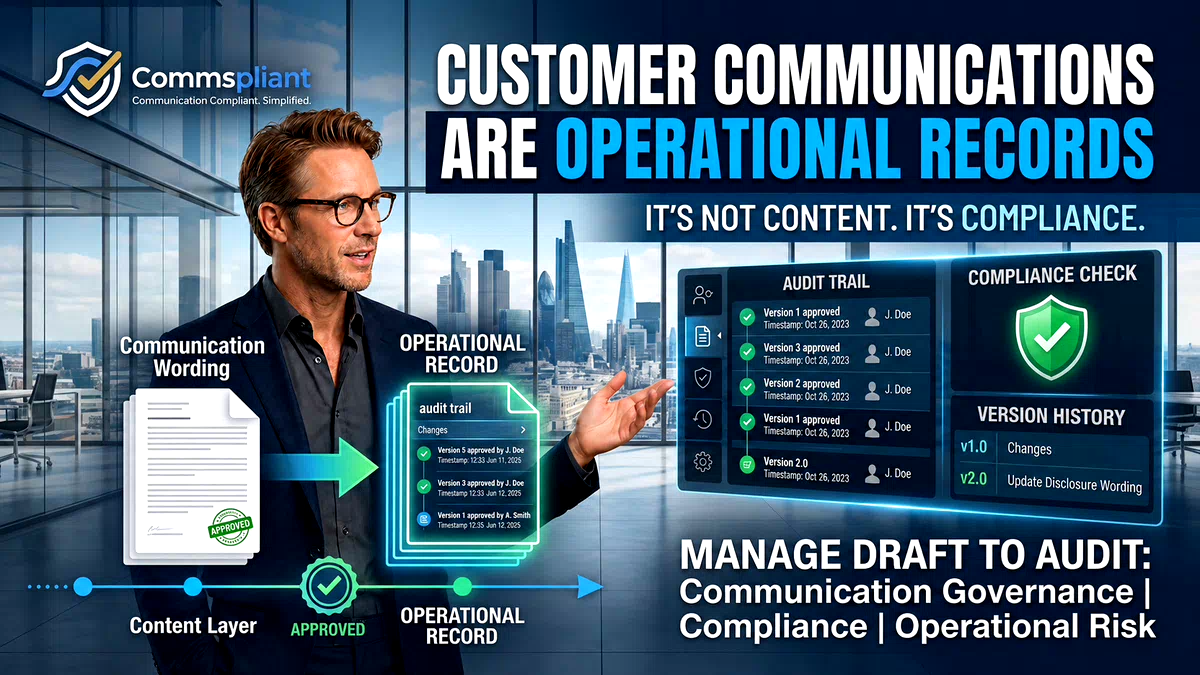

In many businesses, a customer email or PDF template is treated simply as content. If a phrasing adjustment is needed or a layout requires updating, someone modifies the asset, updates the system and moves forward.
But for regulated financial services firms, fintech platforms, pension providers and other regulated organisations, customer-facing communications carry a different level of responsibility.
When an automated email, PDF statement or digital notice explains customer rights, payments, product changes, decisions, disclosures or next steps, it is no longer just content.
It becomes part of the operational record.
The Core Challenge: Reconstructing What Happened Later
Consider a common operational scenario.
An internal audit, customer complaint, legal review or regulatory question requires the business to show what a customer was told at a specific point in time.
The question may sound simple:
Can we prove which version of this communication the customer received, when it was approved and when it went live?
For many teams, answering that question is not simple.
The wording may have been stored in a shared folder. The approval may be buried in an email chain. The live template may sit inside application code. The latest version may not match the version that was sent months ago.
Instead of having a clear customer communication compliance audit trail, teams have to reconstruct the answer manually.
That creates delay, uncertainty and operational risk.
Why Conventional Tools Fall Short
Many regulated teams manage important communication wording across tools designed for general business use:
shared folders
spreadsheets
email approvals
developer tickets
code repositories
manual publishing checks
Each tool may solve one part of the process. But together, they rarely provide a complete governance trail.
Shared folders can make it difficult to know which version was final.
Spreadsheets can become outdated quickly.
Email chains can hide important approval decisions.
Code repositories can show that a technical change happened, but they may not provide an accessible business record of who approved the wording, why it changed and when it became live.
When approved wording lives across disconnected environments, maintaining a reliable audit trail becomes slower and more manual than it needs to be.
Shifting to a Communication Governance Framework
Regulated teams need a clearer way to manage customer-facing wording from draft to approval to publication.
A mature communication governance process should help teams answer practical questions such as:
Who changed the wording?
Who reviewed it?
Who approved it?
When did it go live?
Which version was active at the time?
Which version did the customer receive?
Can the business reconstruct the record later?
This does not mean every wording update should become slow or bureaucratic.
It means the process should be controlled, visible and easy to evidence.
Four Pillars of Better Control
1. Clear approval workflow
Teams need a defined route from draft to review to approval. Important communication changes should not depend on scattered emails, informal messages or manual reminders.
2. Controlled version history
Every approved version should be recorded, with a clear history of what changed, when it changed and who approved it.
3. Separation from the codebase
Customer communication wording should not always require a software deployment. Engineering should connect the system safely, while approved business and compliance users manage communication changes through a controlled workflow.
4. Audit-ready records
If the business needs to prove what was sent, when it changed and who approved it, the answer should be easier to find without a manual investigation across multiple systems.
Aligning Workflows with Operational Reality
Customer communications are not just words on a screen.
In regulated environments, they can become evidence of what the organisation told the customer, when it was approved and which version was sent.
Treating them as operational records helps reduce version confusion, improve audit readiness and protect engineering teams from unnecessary wording-change work.
Where CommsPliant Fits
CommsPliant is a working platform that helps regulated teams manage approved customer emails and PDFs in a controlled workspace, with approval workflows, version history, audit logs and API rendering.
The goal is simple: help business and compliance teams manage communication changes with more control, while reducing unnecessary dependency on engineering for every wording update.
CommsPliant is a working platform for regulated businesses that manage customer emails, PDFs or letters through fragmented workflows and want a clearer, more auditable way to control communication changes.
General Information Notice
This article is for general information only and does not constitute legal, regulatory or compliance advice. Regulated firms should consult qualified compliance or legal professionals when interpreting specific obligations.
Book a discovery call
If your team manages customer emails, PDFs or letters through fragmented workflows, shared folders, developer tickets or manual approval processes, book a discovery call or contact us to discuss CommsPliant.