

Within less than a year, the Solicitors Regulation Authority published two important pieces of evidence about the high-volume consumer claims market.
The first examined what was happening inside law firms.
The second asked consumers what the claims process felt like from their side.
The reports looked at different evidence and identified a wide range of concerns. They do not suggest that every problem was caused by one technology, one system or one communication failure.
Together, however, they raise an important operational question:
Can a firm demonstrate not only that the correct client information existed, but exactly what each client received?
What the SRA found inside law firms
On 22 August 2025, the SRA published the findings of a thematic review into firms handling high-volume consumer claims.
These claims may involve areas such as:
financial products;
motor finance;
diesel emissions;
housing disrepair;
data breaches; and
flight delays.
They can provide an important route to redress, particularly where consumers might not otherwise be able to afford to pursue a claim.
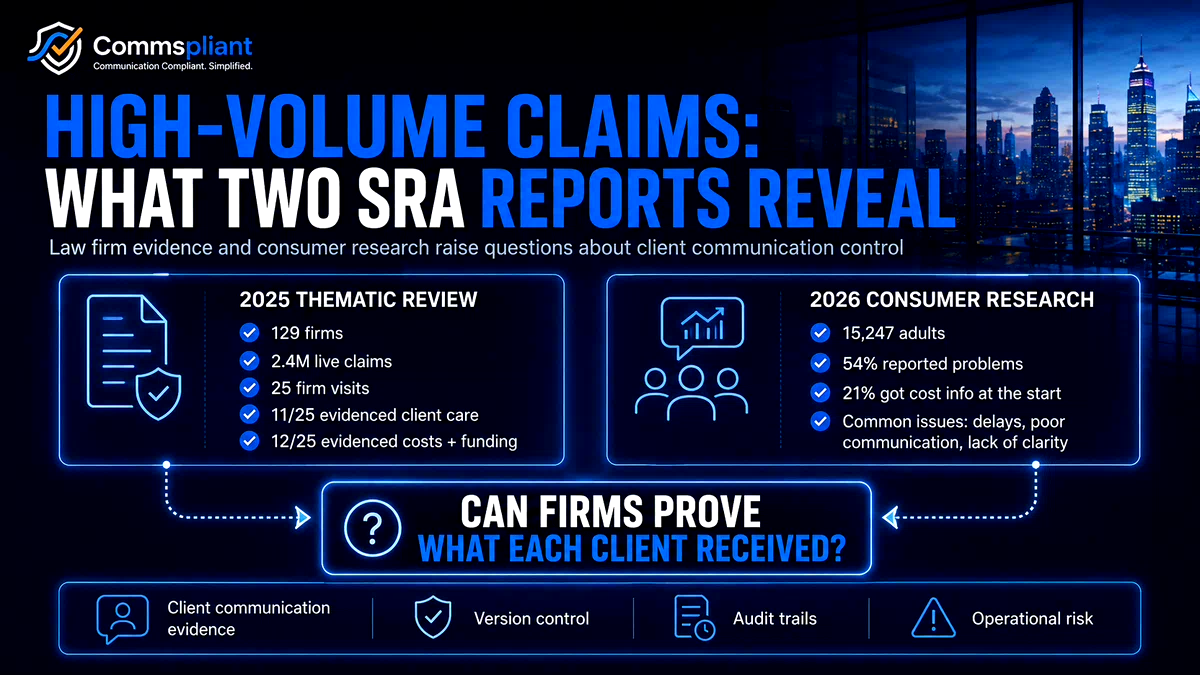
For the review, the SRA surveyed 129 law firms that were collectively handling more than 2.4 million live claims.
It then conducted detailed visits to 25 firms and reviewed 50 client files.
The review identified examples of good practice, but it also raised significant concerns about whether some firms were meeting their professional and regulatory obligations.
Only 11 of the 25 firms visited could evidence that they had provided all claimants with the required client care information when taking them on.
Only 12 of the 25 firms had records proving that all required information about costs and claim funding had been shared.
The SRA also identified concerns involving:
funding and referral arrangements;
After the Event insurance;
transparency around potential liabilities; and
whether firms were acting in their clients’ best interests.
The SRA opened formal investigations into nine of the 25 firms it visited.
In practical terms, the review was examining two connected questions:
Were clients given the information they needed before agreeing to proceed?
And:
Could the firm produce reliable evidence showing that the information had been provided?
Those are not necessarily the same thing.
A firm may have produced an accurate client care document. But when thousands of similar matters are moving through a high-volume operation, the existence of a correct document does not automatically prove that every client received the correct version at the correct time.
What consumers experienced
On 2 July 2026, the SRA published a second major piece of research.
This time, the focus shifted away from firms’ internal processes and towards consumers’ direct experiences of the high-volume claims market.
The independent research, conducted by YouGov for the SRA, used a mixed-method approach.
It included:
a nationally representative survey of 15,247 adults in England and Wales; and
30 detailed interviews with people who had made a claim during the previous five years.
The SRA also noted that the survey responses were based on participants’ recollections and could not be independently verified.
The findings presented a mixed picture.
Fifty-nine percent of claimants with a resolved claim said they were satisfied with the outcome.
However, 54 percent reported experiencing problems during the process.
The most common issues included:
delays;
poor communication; and
a lack of clarity.
Many consumers were also uncertain about when they had formally agreed to begin a claim.
Among those using a law firm or claims management company:
only 21 percent said they had received information about costs at the beginning of the process;
only 13 percent recalled receiving information about a cooling-off period; and
14 percent reported receiving information about potential liabilities.
The distinction between outcome and service is particularly revealing.
Among consumers whose claims were resolved through a law firm, 72 percent said they were satisfied with the outcome.
Yet only 51 percent were satisfied with the service they received.
A consumer may therefore reach an acceptable result while still finding the journey confusing.
They may not clearly understand:
when they agreed to proceed;
what the claim might cost;
what financial liabilities they could face;
who was handling the claim;
what would happen next; or
why the process was taking longer than expected.
Two reports, two sides of the same market
The two SRA reports examined different kinds of evidence.
The 2025 thematic review looked inside firms. It considered files, internal practices, funding arrangements, supervision and professional responsibilities.
The 2026 research listened directly to consumers. It explored their understanding, satisfaction and experience of the claims journey.
The reports should not be treated as proving that one particular operational weakness caused every problem consumers experienced.
The SRA identified broader issues involving:
professional judgement;
business models;
funding arrangements;
marketing;
supervision; and
firms’ duties to act in their clients’ best interests.
Technology cannot replace those responsibilities.
A version-control system cannot decide whether a funding arrangement is in a client’s best interests.
An audit log cannot determine whether legal advice is appropriate.
A workflow cannot replace professional supervision or ensure that a client has genuinely understood complex information.
But the reports do expose a narrower operational risk around the control and evidencing of client communications.
Creating the right document is only the beginning
Consider a typical client care communication.
A legal or compliance team prepares the wording.
A senior person reviews it.
The approved document is placed in a shared folder or added to a case management system.
At that point, the organisation may believe the communication risk has been controlled.
But several things can happen afterwards.
A revised version may be uploaded while an older version remains available elsewhere.
A member of staff may download a local copy and continue using it after the central document has changed.
A template may be edited without a clearly recorded approval.
Different departments or offices may use slightly different wording.
An email may contain the correct attachment but outdated explanatory text.
A case management record may show that a letter was sent without clearly linking the final communication to the exact approved template version used to generate it.
These are examples of potential operational weaknesses, not findings attributed to every firm examined by the SRA.
Their significance is scale.
When a process is used for one client, an isolated error may affect one matter.
When it is repeated across tens of thousands of similar claims, a small weakness can spread quietly through a large client population.
When storage is mistaken for control
Shared drives, document libraries and case management systems can be valuable components of a law firm’s technology environment.
But storing a file is not the same as governing the complete communication lifecycle.
A folder may show where a document is located.
It may not automatically establish:
which wording was formally approved;
who approved it;
when the approval happened;
whether the approved version was subsequently changed;
which version was live on a particular date;
which version generated a specific client communication;
what attachments were included; or
what the client ultimately received.
When those connections are missing, a firm may need to reconstruct events from several places.
The approved wording may be in one folder.
The approval conversation may be in an email thread.
The final PDF may be attached to a client record.
The template history may be managed by a separate technical team.
The evidence that the communication was sent may exist somewhere else again.
Months or years later, following a complaint, audit or regulatory enquiry, the question is no longer simply:
“Did we create the correct information?”
It becomes:
“Can we demonstrate what this particular client received, which approved wording produced it and what evidence supports that history?”
What communication governance can contribute
Communication governance does not decide what legal advice should be given.
It controls the operational path through which approved communications are created, reviewed, released, generated and retained.
A governed communication process may include:
version-controlled templates;
separation between editing and approval responsibilities;
recorded approval decisions;
clear effective dates for each released version;
controlled generation of emails, letters and PDFs;
traceability between an output and the template version that produced it;
records of the attachments included;
downloadable evidence for later review; and
an audit history showing who changed, approved or released each version.
These controls cannot guarantee that a client has understood the information.
They can, however, help a firm demonstrate which information was selected, approved and delivered through its systems.
That distinction matters.
Consumer understanding remains a professional and operational responsibility. Communication evidence supports that responsibility, but does not replace it.
Where CommsPliant fits
CommsPliant is a controlled layer for customer and client communications.
It is not intended to replace a law firm’s:
case management system;
legal judgement;
compliance function; or
professional supervision.
Instead, it connects with existing systems through an API. This allows firms to retain their existing case management platform while adding a governed layer for creating, reviewing, approving, generating and evidencing client communications.
Approved templates can be maintained and version-controlled in a structured workspace, rather than spread across application code, local copies and disconnected folders. Editing and approval responsibilities can be separated, while changes and approval decisions are recorded.
Emails, letters and PDFs can be generated from the approved version.
The resulting communication can remain connected to the template version, attachments and approval evidence behind it.
CommsPliant helps organisations answer practical questions such as:
Which wording was approved at the time?
Who reviewed and approved it?
When did that version become active?
Which version generated this communication?
What information and attachments were included?
What was delivered to this particular client?
What evidence can be retrieved if the communication is questioned later?
CommsPliant is a working platform open to new clients and potential design partners experiencing these communication-control problems.
High volume magnifies small weaknesses
The two SRA reports are not simply stories about missing documents.
They show how professional responsibilities, consumer understanding and operational evidence can become tightly connected in high-volume services.
Clear wording matters.
Appropriate legal advice matters.
Transparent information about costs and funding matters.
Professional judgement, supervision and acting in the client’s best interests matter.
But firms also need reliable control over the way approved communications move from creation to delivery.
At high volume, a small break in that chain can be repeated across many clients.
And when a complaint, audit or regulatory question arrives, having the correct document somewhere in a folder may not be enough.
Because storage tells you where a file is.