
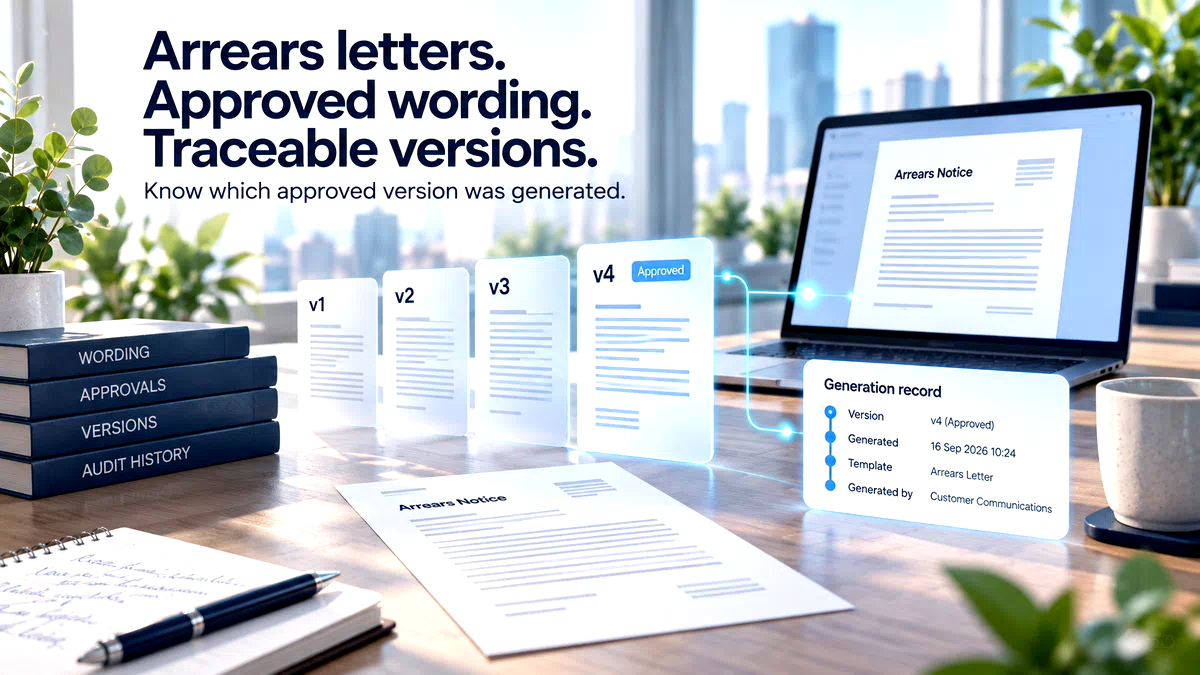
A customer complains about an arrears letter from the spring. The creditor asks for the exact wording. Your team can open today's template, but nobody can say for certain which version was live on the day that letter was generated.
There is no single “CONC 7 arrears notice”. The formal notice of sums in arrears comes from the Consumer Credit Act 1974, sections 86B and 86C. CONC 7 sets the conduct standards around arrears communications: forbearance, information on the debt and the options, signposting to free debt advice, and how you contact the customer. Getting the wording right is the first job. Showing which approved version generated a particular customer's letter is the second.
Is the arrears notice a CCA requirement or a CONC 7 requirement?
The statutory notice is a CCA requirement, and the duty sits with the creditor or owner.
- Fixed-sum credit and consumer hire (section 86B). In summary, the duty arises when at least two payments have fallen due, the customer has paid less than required, and the shortfall is at least the sum of the last two payments due. Where every payment falls due weekly or more often, both figures become four. For such an agreement made before the beginning of the 20-week period ending with the latest payment due, only amounts resulting from missed payments due in those 20 weeks count towards the shortfall. The duty does not arise if the creditor or owner is already under a duty to give these notices, or if a judgment sum is still unpaid. The first notice is due within 14 days, then further notices at intervals of no more than six months. The duty to give further notices ends when the customer is no longer in arrears or a judgment requiring payment is given. If either event occurs before the first required notice is given, that first notice must still be given.
- Running-account credit (section 86C). The duty arises when at least two payments have fallen due and the last two have not been made, unless a notice has already been required for either payment or a judgment sum is still unpaid. The notice is due no later than the end of the period within which the next statement under section 78(4) must be given, and it can be included in that statement.
- Out of scope. Non-commercial and small agreements are excluded from both sections, and green deal plans from section 86B.
- Both notices must include a copy of the current arrears information sheet.
- A late notice (section 86D) means the creditor cannot enforce the agreement during the period of non-compliance. The customer is not liable for interest calculated by reference to that period or the default sums covered by section 86D(4).
This is a summary. Check every applicability condition in sections 86B and 86C before relying on it.
Since 15 July 2026, section 86B does not apply to regulated deferred payment credit agreements. Those agreements have their own missed-payment requirements under CONC 7.20.1R: notification as soon as possible after a missed payment, with the required information provided together.
What must the statutory notice contain?
Sections 86B and 86C leave form and content to regulations: the Consumer Credit (Information Requirements and Duration of Licences and Charges) Regulations 2007, regulation 19 (which applies subject to regulations 20 to 23) for section 86B notices, regulation 24 for section 86C notices, and Schedule 3. In summary:
Fixed-sum credit and consumer hire (regulation 19)
- Opening wording that the notice is given under the 1974 Act because the customer is behind with sums payable under the agreement, and wording encouraging them to discuss the account with the creditor or owner.
- The date of the notice, the creditor's or owner's name, telephone number and postal address, a description that identifies the agreement, and the opening balance on the date the duty arose (Schedule 3, paragraphs 1 to 3).
- Prescribed statements on default sums and interest, and on further notices (paragraphs 4 and 5).
- First notice: the shortfall that triggered the duty (Part 2). Unless the notice already gives the required breakdown, it must invite the customer to ask for details of each missed sum. The creditor or owner must provide the required details within 15 working days of receiving the request.
- Later notices: an account of the period, covering the overdue part of the opening balance, payments, interest and charges, other movements, the closing balance and the overdue part of it (Part 3).
Running-account credit (regulation 24)
- Opening wording explaining that the notice is given in compliance with the 1974 Act because the customer is behind with payments, and wording encouraging discussion of the account.
- The date, a description that identifies the agreement, and the creditor's contact details (paragraphs 14 to 16).
- For each of the last two missed or partly paid payments: the amount, the due date, any part payment and its date, and the total payable less the total paid (paragraph 17).
- Prescribed statements on missed and partly made payments, and on default sums and interest (paragraphs 18 and 19).
Both types of notice
- The prescribed statement about the FCA arrears information sheet (Part 5).
- If the notice says it is not a demand for immediate payment, it must explain why (regulations 19(4) and 24(2)).
The regulations prescribe exact wording, so check the full text of regulation 19 or 24 and Schedule 3 before you finalise a template. One practical consequence: a single arrears process has to produce different notice content for a first fixed-sum notice and for later ones.
What does CONC 7 expect from an arrears letter?
CONC 7 applies to firms carrying out the activities specified in CONC 7.1.1R, including consumer credit lending, consumer hiring and debt collecting, subject to the chapter's application provisions. The FCA Handbook shows the chapter as last updated on 15 July 2026. That does not mean every provision changed on that date. For an arrears letter, these are the provisions to check.
Rules
- Treat customers in or approaching arrears, or in default, with forbearance and due consideration (CONC 7.3.4R).
- Give the customer, or someone acting for them, information on the amount of the arrears and the balance owing (CONC 7.4.1R).
- Anyone contacting the customer on the firm's behalf must explain who they work for, their role and the purpose of the contact (CONC 7.9.1R).
- Do not word a communication so that the customer gets in touch misunderstanding why (CONC 7.9.2R).
- Do not misrepresent your authority or legal position, use official-looking documents likely to mislead about your status, or suggest action can or will be taken when legally it cannot (CONC 7.11.1R, 7.11.3R and 7.11.6R).
- Take reasonable steps so that third parties do not learn the customer is being pursued for a debt (CONC 7.9.7R).
Guidance
- Make timely, clear and understandable information available. It should reflect the customer's circumstances, explain their position on the debt including how it is reported to their credit file, and set out their options, including how any forbearance would affect the balance and the credit file. Consider changing channel if that helps the customer engage. The same provision reminds firms of Principle 7 or the Consumer Duty, as applicable (CONC 7.3.13AG, dated 26 June 2026).
- Where appropriate, tell the customer that free and impartial debt advice is available, explain how it could help, and refer them. Providing the current arrears information sheet is one way to make that referral (CONC 7.3.7AG).
- Mark post “private and confidential” or similar, and keep a debt-collection business name out of sight of third parties (CONC 7.9.8G).
Do the rules require you to keep the template version?
The provisions discussed here do not expressly require a template-version identifier. The record-keeping requirement is general: SYSC 9.1.1R requires a firm (other than a common platform firm) to keep orderly records sufficient for the FCA to monitor its compliance and, in particular, to ascertain that it has met its obligations to clients. CONC 7.6.15G, in its section on continuous payment authorities, points consumer credit firms back to that rule.
The link to template versions is an operational one, not a regulatory instruction. To assess the wording of a particular generated letter, your records need to identify the wording used for that generation.
Why is it hard to show which version generated a letter?
Arrears wording rarely lives in one place. The letter system holds the template. A creditor asks for its own variant. A wording change was approved last quarter in an email thread. The arrears information sheet is a separate enclosure.
Time adds a second layer. While the section 86B duty to give further notices continues, those notices must be given at intervals of no more than six months. One account can therefore hold letters generated from several template versions. When a complaint, a creditor audit or a supervisory request asks what the customer was told on a given date, today's template is the wrong answer.
What should the record for each arrears letter show?
A practical checklist, offered as an operational example rather than a regulatory list. The template version is not the whole letter, so the record needs to connect that version to what was actually generated:
- The template and the version used.
- Who approved that version, and when.
- The creditor variant, where creditors have their own wording.
- The variable data merged into the letter, such as names, amounts and dates, or a reference to the exact historical data record used.
- The enclosures, including which arrears information sheet.
- The account reference and the generation time.
- A readable copy of the generated letter, or enough information to reconstruct its content and presentation accurately. A hash can confirm whether a copy matches the generated output, but it is not a copy.
- Sending and delivery status from the print or email provider, kept as a separate record.
Where CommsPliant fits
CommsPliant keeps arrears and collections templates under version control, with review and approval before a version can be used. The platform does not let the person who created or edited a version approve it. Connected systems request a letter by template identifier, and CommsPliant generates it from the latest approved version at that moment. The CommsPliant Evidence Vault links each generated letter to the approved version used and the generation time. By default it holds a cryptographic hash of the output, not a readable copy; the full document is kept only where that has been agreed. CommsPliant does not decide whether your wording meets the CCA or CONC 7, and generating a letter is not evidence that it was sent or delivered. See how this works for debt collection and consumer credit teams.