
Checked against sources on 9 October 2026.
A customer complains that last month's arrears letter said something different from what your agent told them on the phone. The complaint response deadline is now running. The team now has to show what the letter said, which approved wording it came from, and how that wording was checked.
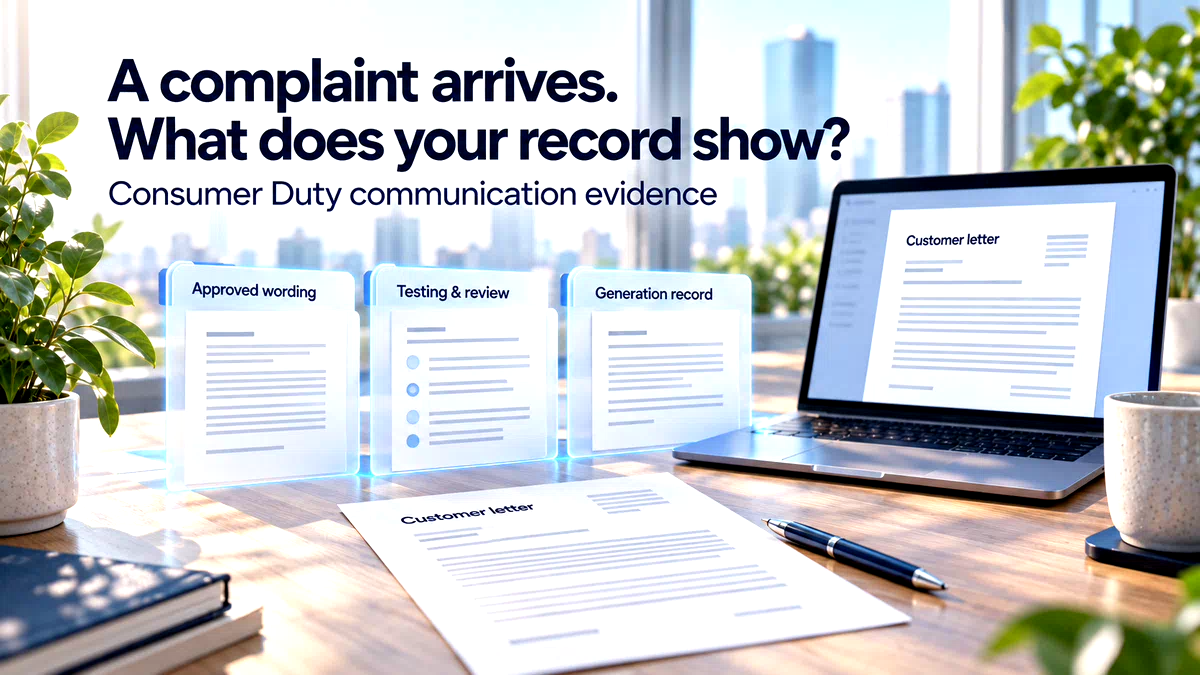
Where the Consumer Duty applies, the useful evidence is a chain, not a single document. It runs from the approved wording, through any testing and review of that wording, to the letter generated for this customer. In March 2026, the FCA reported weaknesses in how some firms evidenced communications testing, documented changes and checked their impact.
What does the Consumer Duty ask of communications?
The consumer understanding outcome sits in PRIN 2A.5 of the FCA Handbook, and outcome monitoring in PRIN 2A.9. For an arrears letter, these are the provisions to check.
Rules
- Communications must meet customers' information needs, be likely to be understood, and equip them to make effective, timely and properly informed decisions (PRIN 2A.5.3R).
- Communicate in good time for customers to make effective decisions (PRIN 2A.5.5R).
- Tailor communications, taking into account customer characteristics including vulnerability, the product and the channel (PRIN 2A.5.8R).
- Where appropriate, test communications before sending them and regularly monitor their impact. If problems emerge, investigate and correct them (PRIN 2A.5.10R).
- Monitor the outcomes customers experience from your communications, and be able to tell whether they have the information they need to make informed decisions (PRIN 2A.9.8R and 2A.9.9R).
Guidance
- Whether to test depends on factors including the communication's purpose, its reach, customer vulnerability, the potential for harm and urgency (PRIN 2A.5.12G). Arrears letters go to customers who may be in financial difficulty, which bears directly on the vulnerability and harm factors.
- PRIN 2A.9.15G points firms to the high-level record-keeping requirements in SYSC 3 and SYSC 9. Firms must decide what records they need to retain for their Consumer Duty obligations.
CONC 7 points the same way for arrears communications: CONC 7.3.13AG reminds firms of their communication obligations under Principle 7 or the Consumer Duty, as applicable. Our first article in this series covers what CONC 7 and the Consumer Credit Act require in arrears notices.
How long do you have once a complaint arrives?
Where DISP 1.6.2R applies, the standard deadline is eight weeks after the firm receives the complaint. By then it must send either a final response or a written response explaining why it cannot give one yet and when it expects to, with the Financial Ombudsman Service information the rule sets out. This is not a universal deadline: complaints about payment services and e-money have different time limits (DISP 1.6.2AR).
The evidence question sits inside that window. If the file cannot show which wording produced the letter, someone has to rebuild the answer from template folders, approval emails and system logs while the investigation runs. If the customer then refers the complaint to the Ombudsman, the same question comes back.
What did the FCA find about firms' evidence?
On 13 March 2026 the FCA published good practice and areas for improvement on the consumer understanding outcome. It drew on a September 2025 survey of 38 firms across insurance, retail banking, payments, consumer finance and CFD providers, alongside supervisory work and research.
Under management information and testing, the FCA reported that:
- some firms said they had tested their communications but provided little evidence;
- several firms relied on sales data or the absence of complaints as evidence of understanding;
- records often failed to show what had changed, why it had changed, or the effect on customers.
Arrears letters appear as a good-practice example: a smaller firm prioritised two high-impact communications for testing with vulnerable customers, its arrears letters and its renewal webpage.
The publication does not create new regulatory requirements. It helps firms assess their approach to testing, monitoring and documenting improvements. For a complaint investigation, a useful operational record also connects those activities to the wording used for the customer's letter.
What should the record show for one arrears letter?
This is an operational checklist, not a regulatory list. It follows the chain from wording to letter:
- the approved version the letter was generated from, and the generation time;
- who approved that version, when, and against which instruction (creditor or internal);
- what changed from the previous version, and why;
- what testing or review the wording had and what it found, or a note that it was not tested and why;
- the variable data and enclosures in the letter as generated, or a readable copy;
- relevant call recordings or notes, where available, so the team can compare the written communication with what the customer was told;
- sending and delivery status, kept as a separate record;
- complaints and customer contacts tagged with the same version.
Linking complaints and customer contacts to the relevant version can help identify patterns and target follow-up testing. Complaint data should be considered alongside other evidence of customer understanding.
Where CommsPliant fits
CommsPliant covers the wording-to-letter part of that chain. Templates are versioned, with draft, approved and superseded wording kept apart, and each version goes through review and approval before it can be used. The platform does not let the person who created or edited a version approve it. Connected systems generate letters from the latest approved version, and the CommsPliant Evidence Vault links each generated letter to the approved version used and the generation time.
By default the Vault holds a cryptographic hash of the output, not a readable copy; the full document is kept only where that has been agreed. CommsPliant does not test communications with customers, decide whether wording meets the Consumer Duty, or prove that a letter was sent or delivered. See how this works for debt collection and consumer credit teams.
A next step
Take the last complaint your team handled about a letter. Check whether the file shows the version the letter was generated from, what has changed in that wording since, and any evidence it was checked for understanding. Whatever had to be rebuilt by hand is the part to fix first.