

When a customer receives an account update, payment notice, policy communication or transaction confirmation, they see one message.
Behind the scenes, that message may sit at the intersection of software engineering, product operations and compliance review.
Because many customer emails are triggered automatically by software systems, businesses often manage them inside application code, marketing automation platforms or shared template libraries.
Those tools can be useful for delivery, design and technical control. But they do not always provide a clear, business-facing audit trail of wording changes, approvals and publication history.
That is where the hidden problem begins.
The Illusion of the Automated Log
A common assumption is that if an email template is updated inside a system, the history is automatically easy to prove later.
But when an internal audit, customer complaint or regulatory question arises, the business may need to answer practical questions such as:
What wording was live at the time?
Who reviewed the change?
Who approved it?
When did the approved version go live?
Which version did the customer receive?
Was the previous version removed or replaced correctly?
For many teams, those answers are scattered across multiple systems.
A marketing platform may show when a template was edited, but not always why the wording changed or who formally approved the final version.
A code repository may show that a developer changed a file, but that technical record may not explain the business approval process behind the wording.
An email chain may contain the sign-off, but it may be disconnected from the final version that actually went live.
The result is not always a missing record.
Sometimes the bigger problem is that the record exists in too many places.
Why Email Templates Create Audit Trail Gaps
Customer email templates often look simple from the outside. But inside regulated businesses, they can contain wording that matters:
fee explanations
payment information
policy changes
pension updates
product notices
complaint responses
customer rights or obligations
regulatory disclosures
When this wording changes, the business may need more than a record that “something was updated.”
It may need a clear history of the decision.
That includes what changed, why it changed, who approved it and when the approved version became active.
When the wording, approval and technical release all live in separate places, the audit trail becomes harder to follow.
The Operational Cost of Fragmented Records
Fragmented email governance creates two problems at the same time.
First, it slows teams down.
A small wording update may need to move through compliance, product, operations and engineering before it can go live. If there is no controlled workflow, the process often depends on manual reminders, email chains and developer availability.
Second, it makes evidence harder to produce later.
If a customer asks what they were told, or an auditor asks when a version changed, the business may need to reconstruct the answer manually.
That can mean checking old tickets, reviewing email threads, asking developers to inspect code history and comparing archived templates.
This is slow, frustrating and avoidable.
What a Better Template Audit Trail Looks Like
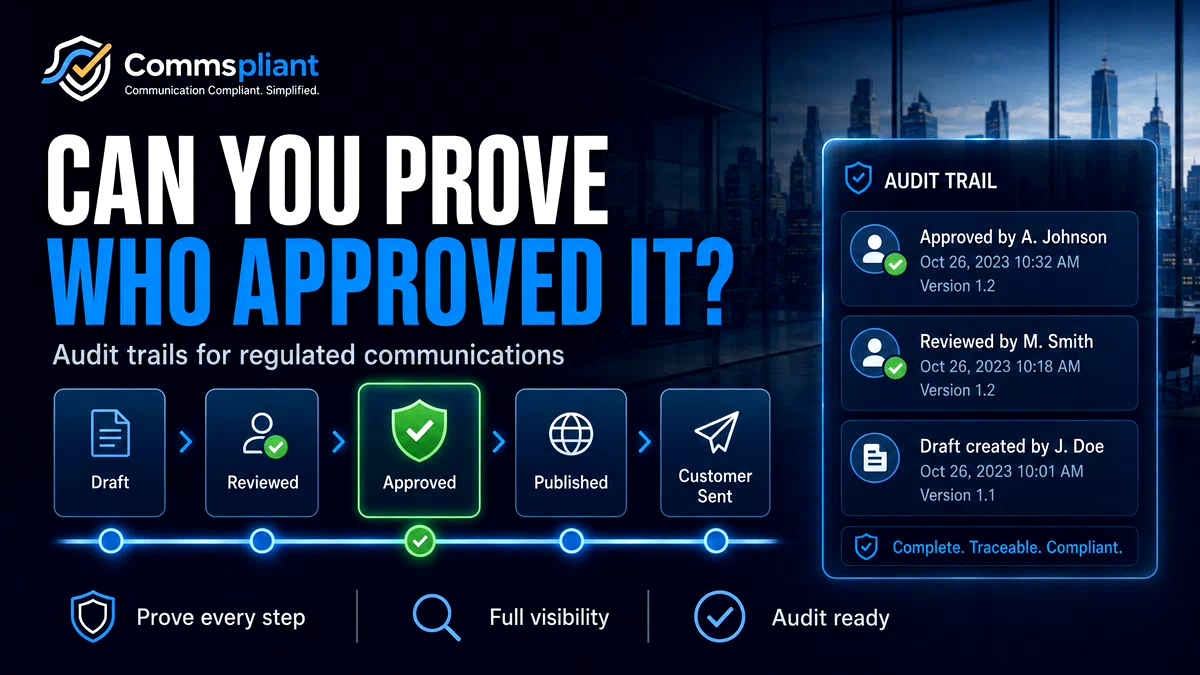
A stronger approach gives customer email templates a controlled lifecycle.
1. Draft
A business or operations user creates or edits the wording in a structured workspace.
2. Review
The change is checked by the right person or team before it can go live.
3. Approval
The approval is recorded with clear ownership and timestamped history.
4. Publication
The approved version becomes available for use by the system.
5. Version history
Previous versions remain traceable, so the business can understand what changed over time.
6. Audit record
If the business needs to prove what happened, the record is available without searching across disconnected tools.
This does not remove engineering from the process.
Engineering still plays an important role in integration, security and system control.
But it reduces the need for developers to manually handle every wording change inside customer email templates.
Separating Email Wording from Application Code
For regulated teams, one of the most useful shifts is separating the communication wording layer from the application codebase.
The application should control the customer journey, data flow and delivery logic.
The approved communication workspace should control the wording, approval status, version history and audit record.
This allows engineering teams to connect the system safely, while business and compliance teams manage approved wording through a controlled process.
It creates a cleaner division of responsibility.
Engineering stays in control of infrastructure.
Compliance stays in control of approved wording.
Operations can move changes through the process with more visibility.
Where CommsPliant Fits
CommsPliant is a working platform that helps regulated teams manage approved customer emails and PDFs in a controlled workspace, with approval workflows, version history, audit logs and API rendering.
The goal is to make customer communication changes easier to control, easier to approve and easier to evidence later.
Instead of relying on scattered email chains, shared folders, developer tickets and code history, teams can manage approved communication wording in one structured process.
General Information Notice
This article is for general information only and does not constitute legal, regulatory or compliance advice. Regulated firms should consult qualified compliance or legal professionals when interpreting specific obligations.
Book a discovery call
CommsPliant is a working platform for regulated businesses that manage customer emails, PDFs or letters through fragmented workflows and want a clearer, more auditable way to control communication changes.
If your team is trying to reduce version confusion, manual approvals or developer dependency in customer communication workflows, book a discovery call or contact us to discuss CommsPliant.