
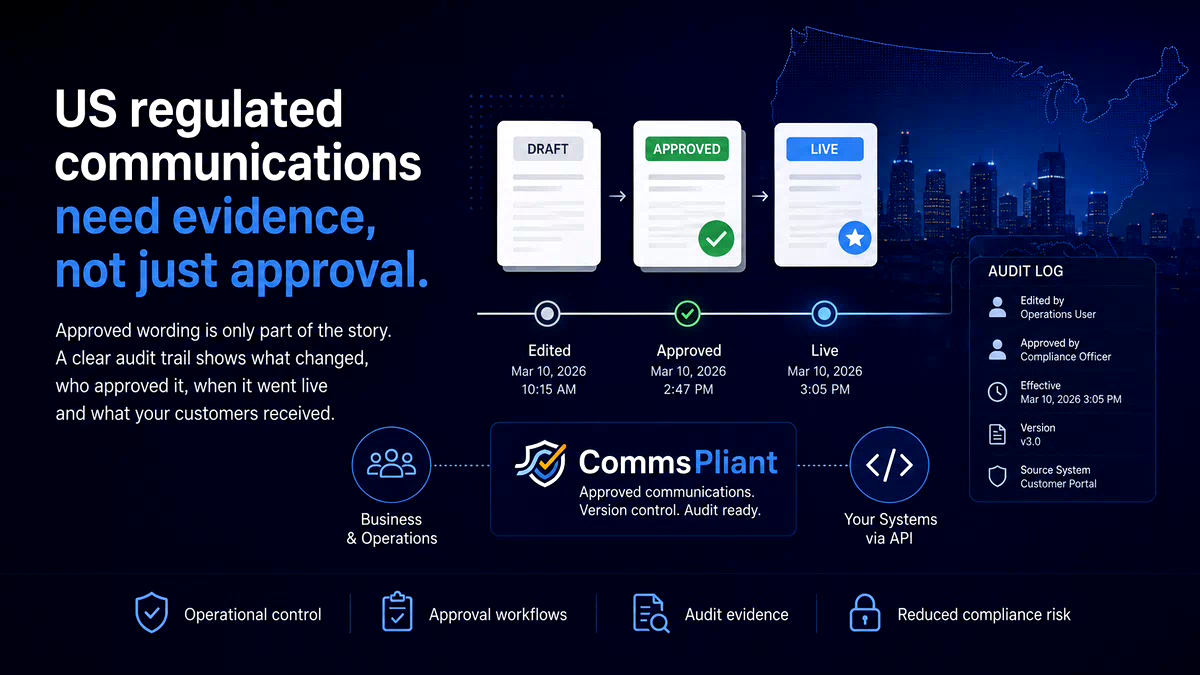

In US regulated businesses, customer communications are rarely just words on a page.
An email, PDF, disclosure, notice or letter may explain a fee, a right, a product feature, a deadline, a limitation, a complaint route or a decision. That makes the communication part of the customer experience, but also part of the operational record.
The wording matters.
But the evidence behind the wording matters too.
A business may later need to show how a communication was changed, reviewed, approved, released and used. That becomes harder when communications are managed across shared folders, email threads, tickets, codebases, CRM tools or document templates that are not connected to one clear approval history.
US regulation creates a practical evidence problem
The US regulatory landscape is not one single rulebook.
A bank, lender, broker-dealer, investment adviser, fintech, insurer or regulated service provider may face different requirements depending on its activities, customers and products.
Those regimes should not be treated as interchangeable. They have different triggers, tests, recordkeeping duties and regulated populations.
But they do point toward a shared operational lesson: customer-facing communications need control, review and evidence.
For example, FINRA Rule 2210 sets standards for broker-dealer communications with the public, including approval, review and recordkeeping requirements for certain communications. Records may need to show the communication itself, dates of use, who approved it and when approval was given.
The SEC has also continued to focus on investment adviser marketing rule compliance. Its examination observations have highlighted issues such as untrue or unsubstantiated statements, misleading omissions, fair and balanced presentation, and recordkeeping or compliance-rule weaknesses.
The CFPB’s UDAAP examination procedures focus on the risk of consumer harm, deception and consumer understanding in financial products and services. In another CFPB circular, the Bureau stated that including unlawful or unenforceable terms in consumer contracts may create deception risk because consumers may believe those terms are enforceable.
The message for regulated teams is practical.
A communication can create risk even when the intended wording was approved somewhere.
The harder question is whether the business can prove that the right wording was approved, published and used at the right time.
Approval is not enough if the trail is fragmented
In many organisations, communications are still treated as an engineering or operational side effect.
A business team writes the change.
Compliance approves it in an email or document comment.
Engineering receives a ticket.
A developer updates the wording inside a template, repository or system.
The change waits for testing and deployment.
Someone screenshots the result.
Someone else stores a copy in a folder.
Later, another version appears in a CRM, portal, PDF renderer or manual process.
Everyone acted responsibly, but the evidence trail is scattered.
That is where the risk starts to grow.
When a regulator, auditor, customer complaint team or internal risk function asks what was sent, the business may need to reconstruct the answer from tickets, pull requests, shared documents, approval emails, deployment history and system logs.
That reconstruction is slow.
It is also fragile.
If one piece is missing, the business may know what it intended to send, but struggle to evidence exactly what happened.
Version confusion can become customer confusion
Customer communications are especially sensitive because small wording differences can change meaning.
A fee explanation may become less clear.
A cancellation instruction may become harder to follow.
A risk warning may be softened.
A deadline may be misstated.
A customer right may be described differently across channels.
In a regulated environment, inconsistent wording is not only a brand problem. It can become a governance problem.
When one team has the approved version, another team has the live version, and a third team has an older version in a shared folder, the organisation no longer has one reliable source of truth.
The question becomes simple:
Which version is the real one?
That question should not require a forensic expedition through inboxes and deployment notes.
A better operating model separates content control from code changes
Engineering should not have to become the permanent gatekeeper for every wording update.
Business and compliance teams should be able to manage approved communication wording in a controlled environment, while engineering keeps control of integration, data handling, security and system behaviour.
That is the operating model CommsPliant provides.
CommsPliant gives regulated and enterprise teams a shared workspace for customer emails, PDFs and document templates, with structured approval workflows, version history, audit logs and API rendering.
Business teams edit.
Compliance reviews and approves.
Engineering connects once and stays in control.
The system records what changed, who approved it, when it became live and which version should be rendered.
That does not replace legal, compliance or regulatory judgement.
It supports the evidence layer underneath it.
The audit question should be easy to answer
For US regulated businesses, the future of communication governance is not only about writing clearer customer messages.
It is about making approved wording traceable.
A strong communication process should make it easy to answer:
What did the customer receive?
Which version was live at that time?
Who approved it?
When was it approved?
What changed from the previous version?
Which system used it?
Can we prove that without rebuilding the story manually?
When those answers live across different tools, the business carries unnecessary operational risk.
When those answers live in one controlled workflow, the communication becomes easier to manage, easier to review and easier to evidence.
In regulated communications, approval matters.
But approval without traceability is only half the story.