
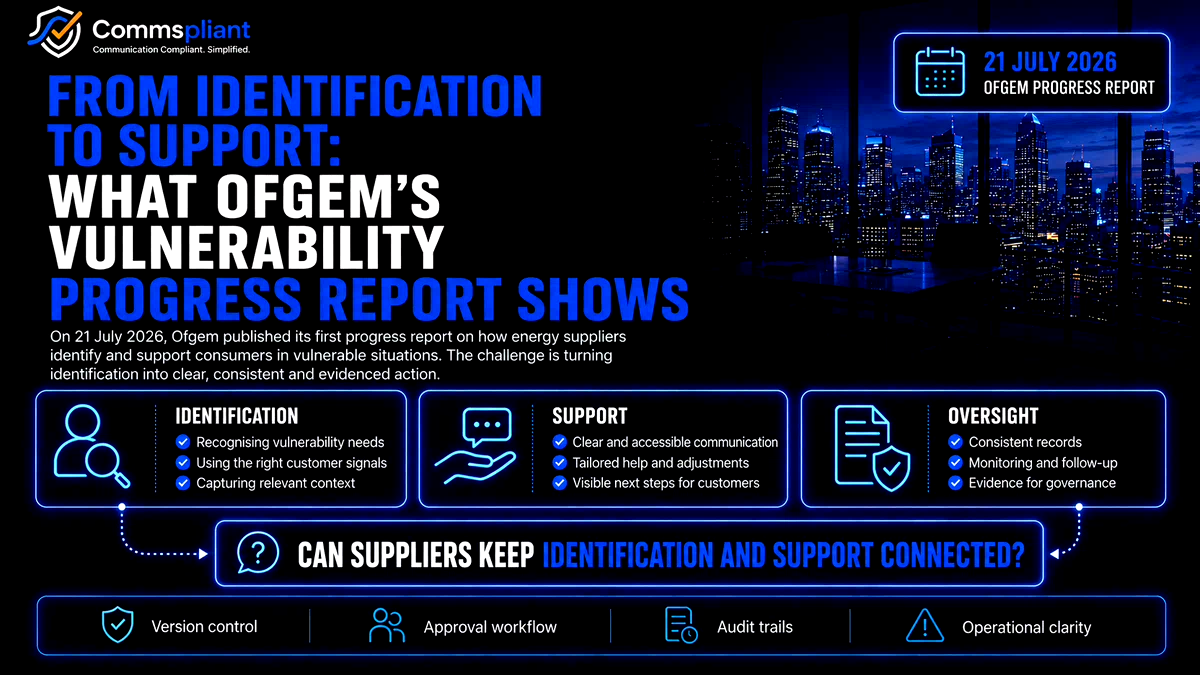
On 21 July 2026, Great Britain’s energy regulator, Ofgem, published its first progress report on how energy suppliers identify and support consumers in vulnerable situations.
The report recognises promising work, but delivery remains uneven. Suppliers are getting better at recognising that a customer may need additional support. The harder question is whether that information consistently changes what happens next.
This was not a formal assessment of supplier compliance or enforcement performance. Ofgem used supplier focus sessions, market data and feedback from consumer organisations to understand how its Consumer Vulnerability Strategy is working in practice.
What Ofgem reviewed and why it matters
Consumer vulnerability is not limited to one type of customer or one permanent condition. It can arise from poor health, a difficult life event, low financial resilience or a person’s ability to understand and act on information.
According to the FCA’s Financial Lives 2024 survey, around 26.4 million UK adults, equivalent to 49% of the adult population, showed one or more characteristics of vulnerability in May 2024. The figure is cited in Ofgem’s report, but comes originally from the FCA’s research.
Ofgem also reports that total domestic energy debt reached a historic high of £4.79 billion in the first quarter of 2026. That does not mean every person in debt is vulnerable, but it shows the scale of the pressure facing customers and suppliers.
Ofgem’s wider message is that having a policy or process is not enough on its own. Suppliers also need to consider whether those arrangements produce useful results for the customer.
For example, recording that a customer needs information in large print is only a starting point. Future communications should then be provided in an appropriate format.
More customers are being identified
The proportion of domestic electricity customers on the Priority Services Register, commonly known as the PSR, increased from around 25% at the end of 2020 to around 32% at the end of 2025.
The PSR is a free service offering eligible customers additional help, including communication support and assistance during interruptions to supply.
Suppliers are also using more information to recognise possible needs earlier. Ofgem describes approaches involving payment and consumption patterns, repeated contact, frontline prompts, staff training, call analysis and external data.
These developments matter because customers do not always identify themselves as vulnerable. They may not know support is available, may feel uncomfortable discussing their circumstances, or may experience needs that change gradually.
However, growing the register is not the complete measure of success. Ofgem describes PSR coverage as a useful signal, but not a sufficient measure on its own. The important question is whether a registration or vulnerability flag leads to timely, practical help.
When customers fall behind
At the end of 2025, around 58% of consumers who were behind with their bills were in arrears without a repayment plan, up from around 49% at the end of 2020.
This does not show that all those customers had already been formally identified as vulnerable. It does suggest that customers who fall behind are not consistently being moved into structured repayment arrangements.
A repayment plan allows a customer to repay debt over time, ideally at a level they can reasonably afford. Without that structure, arrears may continue to grow before longer-term support is arranged.
The average debt balance when an electricity repayment plan was agreed increased from around £698 in 2020 to £1,049 in 2025. The equivalent gas figure increased from £592 to £862. Ofgem says this highlights the importance of engaging earlier.
The report recognises positive practices, including specialist affordability teams, flexible payment options, proactive contact and partnerships with debt-advice organisations and charities. However, these approaches are not yet delivered consistently across the market.
Communication needs to be understandable
Ofgem reports that contacting suppliers has become easier in some respects. Market-average telephone waiting times were around two to three minutes, a substantial improvement compared with previous years.
However, satisfaction with the ease of understanding bills declined slightly, from 85% in July and August 2025 to 82% in January 2026.
Although satisfaction remained relatively high, the decline suggests that bill clarity still requires attention, particularly for customers facing financial, accessibility or communication barriers.
A communication can be accurate and still be difficult to use. A bill may contain the required information but fail to make the balance, payment deadline or available support clear. An accessible format may be available, but only after the customer repeatedly asks for it.
For compliance and operations teams, communication should not be treated as the final administrative step. It is part of the support itself.
Connecting recorded needs with practical action
Governance arrangements are becoming more established across the sector. Suppliers described senior-level vulnerability champions, oversight groups and risk or audit committees.
The remaining difficulty is ensuring that senior-level commitments are reflected consistently in day-to-day operations.
When a customer tells one team about a difficult life event, that information should be available to the teams responsible for future communications and support. Otherwise, the next automated message may fail to reflect what the organisation already knows.
A need recorded during a telephone call may not influence the next email, bill or letter. The customer may then have to repeat the same information or receive communications that do not match the support already discussed.
This is where identification and delivery can separate in practice. A customer’s needs may be recorded correctly, yet fail to influence the next communication or operational action. The challenge is to connect what the organisation knows about the customer with the wording, format and support pathway that follow.
Ofgem found that governance structures are in place across suppliers, but their effectiveness varies. Strategic oversight does not always translate into frontline delivery, while positive frontline activity is not always supported by clear leadership direction or measurement of customer outcomes.
From processes to customer outcomes
The message is not that processes are unimportant. Suppliers still need policies, trained staff, clear responsibilities and reliable records. The point is that activity should be connected to what the customer experiences.
A supplier may record more vulnerability information, but does that result in appropriate support? It may send more messages, but are they understandable and accessible? It may offer short-term help, but does the customer move towards a sustainable arrangement?
Ofgem recommends that suppliers identify vulnerability earlier, move more customers into sustainable repayment arrangements, strengthen evidence of outcomes and connect governance more closely with frontline delivery. These recommendations are intended to support more consistent practice, not create new prescriptive requirements.
Technology cannot decide what support is appropriate for an individual customer or show whether that support improved the customer’s situation. It can, however, help organisations control the communication part of the journey. CommsPliant works alongside existing CRM, billing, case-management and sending systems, helping teams manage approved wording and versions, render the approved communication and retain the associated evidence records. It does not identify vulnerability or replace the human judgement needed to decide what support should be offered.
Ofgem’s report shows that identifying vulnerability is an important starting point, but not the complete measure of success. What matters in practice is whether that information changes how the customer is contacted, the communication they receive and the support they are offered.
Although the report concerns energy suppliers, the operational lesson applies more widely wherever recorded customer needs are expected to influence later communications and service decisions.
Explore CommsPliant: