
🎧 Listen to this article as a podcast on Spotify
An illustrative situation, not a customer case.
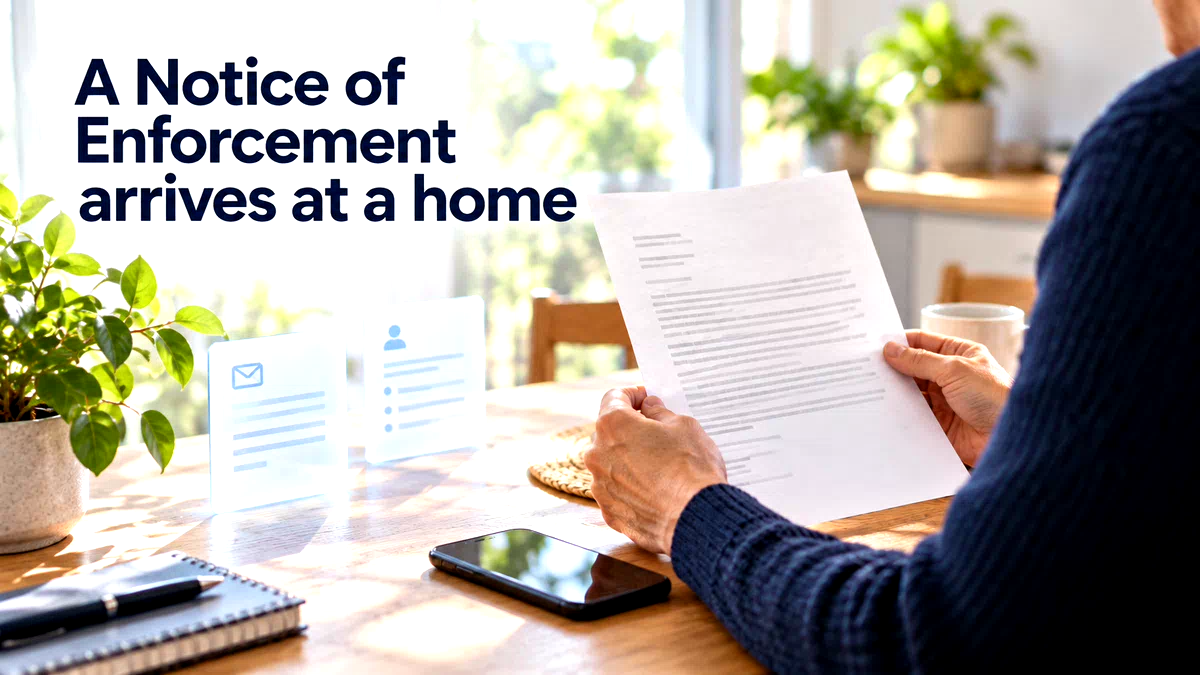
A Notice of Enforcement arrives at a home where the recipient has just lost their job and is caring for a parent. They see the amount, a deadline and a phone number. But they do not realise they can explain the circumstances making it difficult to respond or pay.
The firm has provided a way to make contact. Has the letter made the reason to use it clear?
The Enforcement Conduct Board (ECB) confirms that its vulnerability and ability-to-pay standards take effect from January 2027. For accredited enforcement firms preparing their communications, a useful starting question is: would a person in difficulty know they can tell you, and how?
What does this mean for letters?
FS15.3 requires communications to enable people to disclose needs or personal or financial circumstances that may indicate vulnerability and affect their ability to satisfy the debt. This sits within a wider duty to identify vulnerability proactively; a firm cannot rely only on people volunteering information.
Existing requirements remain relevant. FS2 covers clear, accessible and appropriate communication, early information about advice and complaints, contact routes, confidentiality and retention. FS7.2 addresses complaint information in correspondence.
Retention needs particular care: FS2.7.5 specifies at least three months for written contact. Under FS6.6, complaint-related information must remain available until no longer needed to resolve the complaint and for at least 12 months from the complaint date. Three months is therefore not a universal deletion point.
See the October 2026 standards for firms for the full requirements. The practical checks below are CommsPliant’s operational suggestions, not an ECB checklist or endorsement.
Seven practical checks before January
1. Can the reader recognise that the invitation applies to them?
Read the letter without assuming the recipient knows what “vulnerability” means. Someone dealing with illness, bereavement or a sudden change in income may not describe themselves as vulnerable.
Check whether the wording gives them an understandable opportunity to explain what is making things difficult. Avoid promising a particular outcome before their circumstances have been assessed.
2. Can they find a usable way to respond?
Look at the finished letter, not just the template editor. Are the phone number and alternative contact route easy to find? Are opening hours clear? Test the email address, links and any QR code.
Try the same exercise on a phone screen and a printed copy. A contact route that is technically present can still be difficult to use.
3. Does the information help someone take the next step?
Review the advice and complaint information alongside the payment instructions. Can the reader distinguish contacting your firm, getting independent debt advice and making a complaint?
Check that the destinations still work and that the wording describes what the person will find there. A list of organisation names is less useful if the reader cannot see why or how to contact them.
4. Does the full letter give a consistent message?
A supportive paragraph can be undermined by a contradictory statement elsewhere. Read the opening, deadlines, payment instructions and closing together.
Check statements about what happens next against the actual case stage and operating process. If the letter invites someone to explain their circumstances, the response team needs to know how to handle that conversation.
5. Can you provide an appropriate alternative?
Choose a realistic example: someone needs larger text, a different communication method or help understanding the information. Follow the request through your process.
Who arranges the change? Who checks the resulting communication? Can the person handling the case see what was provided? Test the output itself: enlarging text can move an important phone number or payment detail onto another page.
6. What happens after someone responds?
Follow a fictional disclosure from the letter’s contact route to the team that handles it. Check handovers, access to relevant information and responsibility for the next action.
A clear invitation is useful only when the process behind it can respond. The letter should accurately describe that process, without making assurances the team cannot fulfil.
7. Can you establish what was actually sent?
Distinguish the approved template, the personalised document produced from it and the sending record. A template version alone does not establish the complete contents of an individual letter.
Check whether your records connect the actual communication to the relevant case, approved version and dispatch event, with suitable access and retention controls. Record the scope and outcome of your review as well. Generating a document does not prove dispatch, delivery, reading or understanding.
Start with two letters
Choose your Notice of Enforcement and first follow-up letter. Give the finished examples to a colleague who was not involved in writing them.
Ask them to find where a person can explain difficult circumstances, how to respond and what the letter says will happen next. Note any hesitation or ambiguity, assign an owner to the change and review the revised output.
This small exercise can expose a practical problem that a template-by-template tick-box review misses.
Where CommsPliant fits
CommsPliant supports version-controlled templates, independent approval and traceable document generation. These controls can help teams manage wording changes and connect generated communications with their approved template versions.
The firm remains responsible for the suitability of its wording and its response to individual circumstances. Evidence of dispatch and delivery depends on the sending process and its records. Where only a document hash is retained, that hash cannot recreate the letter; access to the actual output requires an appropriate retention arrangement.
Before January, start with the reader’s question: “Can I tell you what is making this difficult, and how?”