
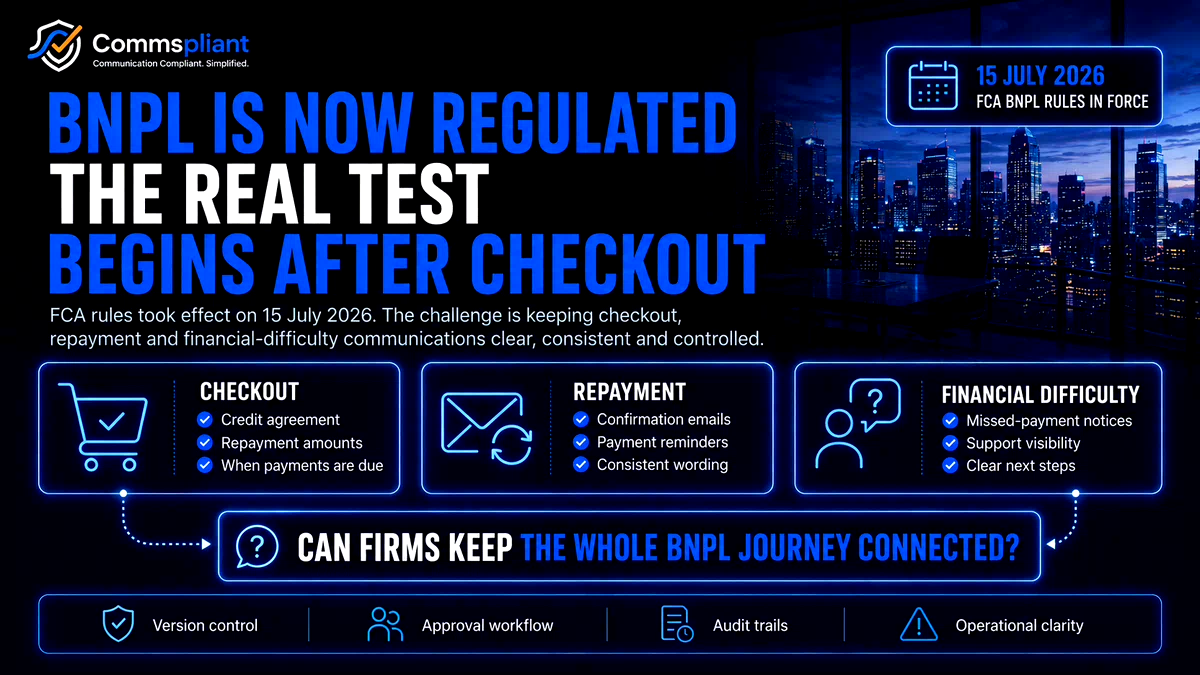

BNPL regulation took effect on 15 July 2026. Explore how third-party lenders can keep checkout, repayment and financial-difficulty communications clear and consistent.
At checkout, Buy Now Pay Later (BNPL) is designed to feel almost effortless.
Choose the payment option. Split the cost. Complete the purchase.
But from 15 July 2026, certain interest-free Buy Now Pay Later arrangements provided by third-party lenders became regulated by the Financial Conduct Authority.
That change introduces stronger consumer protections around information, affordability, financial difficulty and complaints.
It also changes the significance of the messages surrounding the product.
The information shown at checkout is no longer an isolated piece of retail copy. It is the beginning of a regulated customer journey that may continue through confirmation emails, repayment reminders, missed-payment notices and financial-difficulty support.
The important question is therefore not limited to whether the first disclosure was correctly written.
It is whether the entire journey remains clear, consistent and properly controlled as the customer’s circumstances change.
What changed on 15 July 2026?
The new regime applies to certain Deferred Payment Credit agreements offered by third-party lenders.
These are generally interest-free arrangements that allow a customer to divide the cost of a purchase into instalments over a limited period.
Not every product described as Buy Now Pay Later is treated identically. Some interest-bearing instalment products were already regulated, while certain arrangements provided directly by merchants remain outside this particular regime.
For the lenders covered by the new rules, however, the change is substantial.
Consumers must receive information that helps them understand the agreement, including:
how much they will repay;
when payments will be collected;
what may happen if a payment is missed;
what rights and protections are available.
Lenders must also carry out proportionate affordability assessments and provide appropriate support when customers experience financial difficulty.
Consumers can take eligible complaints to the Financial Ombudsman Service.
The FCA has said the Deferred Payment Credit market grew to more than £13 billion in 2024. Its Financial Lives Survey also found that approximately 10.9 million UK adults, equivalent to 20% of UK consumers, had used Deferred Payment Credit during the 12 months to May 2024.
Source: FCA, PS26/1: Regulation of Deferred Payment Credit.
This means the new regime touches a familiar part of everyday shopping rather than a specialist financial product hidden somewhere in the background.
The checkout is only the first conversation
A customer’s first interaction with BNPL may last only a few moments.
They see the option at checkout, review the payment amounts and decide whether to continue.
At that stage, the communication must help the customer understand that they are entering a credit agreement, not simply choosing another way to pay.
But the relationship does not end when the purchase is completed.
The customer may later receive:
confirmation of the agreement;
information about upcoming payments;
reminders before an instalment is collected;
a notice after a failed or missed payment;
information about possible consequences;
details of available support;
directions towards free debt advice;
responses to questions or complaints.
Each communication serves a different purpose.
The tone used to introduce a payment option at checkout cannot simply be copied into a message sent to someone who is struggling to make a repayment.
The same customer may move from shopper, to borrower, to customer in financial difficulty within a relatively short period.
The communication must move with them.
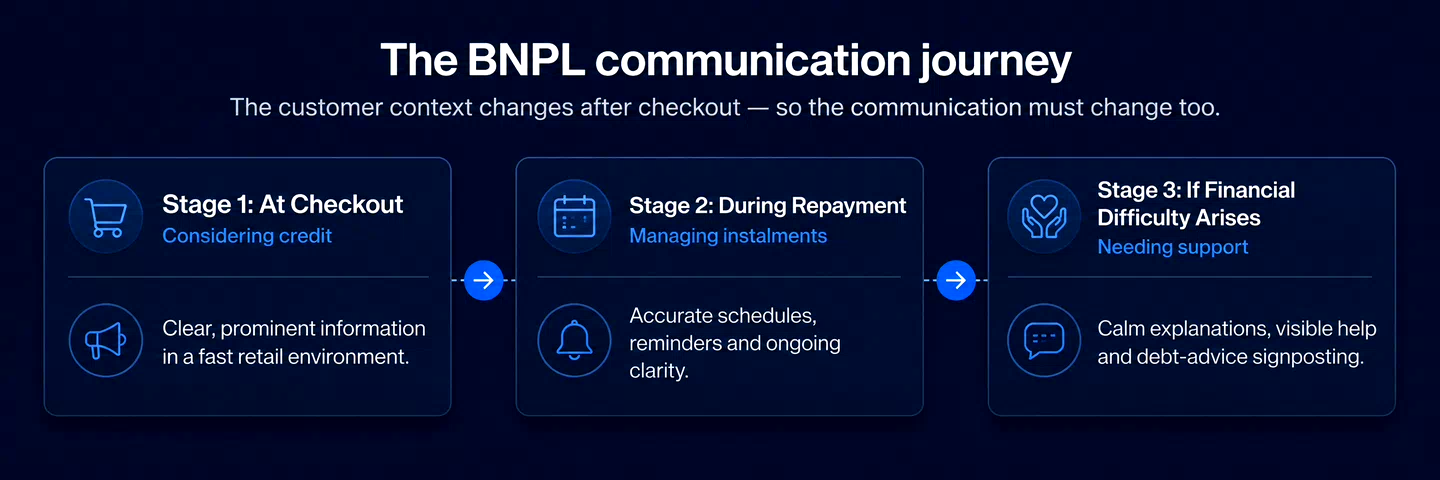
The BNPL communication journey changes as the customer moves from checkout to repayment and, in some cases, financial difficulty. | ||
|---|---|---|
Different moments need different messages
A BNPL journey can begin inside a bright, fast-moving retail environment.
The customer may be comparing products, checking delivery dates and trying to complete a purchase before a discount expires.
Important credit information must therefore compete with product photographs, promotional wording, delivery options and other elements of the checkout page.
Later communications take place in a very different context.
A missed-payment message may reach someone who is worried, confused or experiencing wider financial pressure.
At that point, clarity is not only about simplifying sentences. It also involves:
explaining what has happened without unnecessary alarm;
distinguishing immediate consequences from possible future consequences;
making support visible;
avoiding language that could discourage the customer from asking for help;
ensuring the next step is easy to understand.
This creates a communication challenge that stretches across design, timing, tone and channel.
It is not enough for each message to make sense when reviewed separately.
The journey must make sense as a whole.
Where the BNPL journey can fragment
In practice, these communications may not live in one place.
The checkout information might be managed by a product team.
The agreement summary may be generated through a lending platform.
Payment reminders may sit inside an email service.
Missed-payment messages may be controlled by a collections system.
Customer-service teams may use their own saved responses or documents.
A wording change can therefore reach one part of the journey without reaching the others.
For example:
the website may show updated terminology while the mobile application still uses the previous wording;
a new missed-payment message may be approved but remain waiting for a software release;
the email template may be updated while the downloadable PDF remains unchanged;
customer-service teams may continue using an older saved response;
one product journey may adopt the new wording while another product follows a separate release schedule.
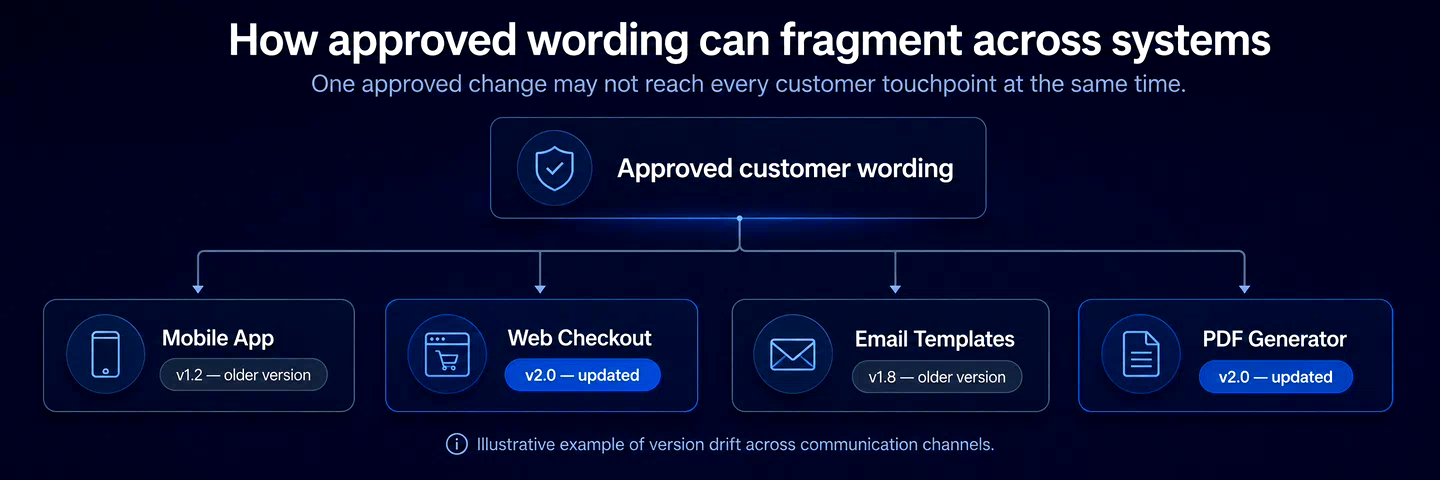
An approved wording change may reach some systems before others, creating different versions across the customer journey. | ||
|---|---|---|
None of these problems necessarily begins with poor regulatory judgement.
They can arise because several teams and systems share responsibility for one customer conversation.
Compliance may approve the meaning.
Product may own the journey.
Operations may manage customer contact.
Engineering may control implementation.
The email or document platform may record what was sent.
Without a joined-up process, the communication can slowly split into several competing versions of the truth.
BNPL moves quickly. Communication changes must keep pace.
Customer communication rules and internal policies do not remain frozen.
A firm may need to change wording because:
customers are misunderstanding part of the journey;
complaints reveal an unclear explanation;
testing identifies information that lacks prominence;
a product feature or repayment process changes;
the FCA publishes additional guidance or findings;
internal policy changes the support offered after a missed payment.
The difficulty is not always deciding that something should change.
The difficulty is moving the approved change into every relevant customer touchpoint without creating delays or inconsistencies.
Where wording is embedded directly inside application code, even a small amendment may require:
a development ticket;
a code change;
technical review;
compliance review;
testing;
deployment.
That process may be necessary for genuine technical changes.
For an approved wording amendment, however, it can leave compliance dependent on an engineering release calendar.
In a fast-moving credit journey, outdated language does not become harmless simply because the updated version is waiting in a development queue.
Consumer Understanding creates a continuous loop
The BNPL rules also sit within the wider expectations of the Consumer Duty.
In March 2026, the FCA published findings relating to the Consumer Understanding outcome.
The FCA described communication design, testing, monitoring and governance as connected parts of an end-to-end process.
Source: FCA, Consumer understanding: good practice and areas for improvement, published 13 March 2026.
This is important because customer communication should not operate as a one-time production exercise:
Write the message. Approve it. Publish it. Forget it.
A more effective process works as a loop:
Identify where customers are confused or struggling.
Review the relevant communication.
Develop and test an improvement.
Obtain the appropriate approval.
Release the change into the relevant customer journeys and communication channels.
Monitor whether the change improves customer understanding.
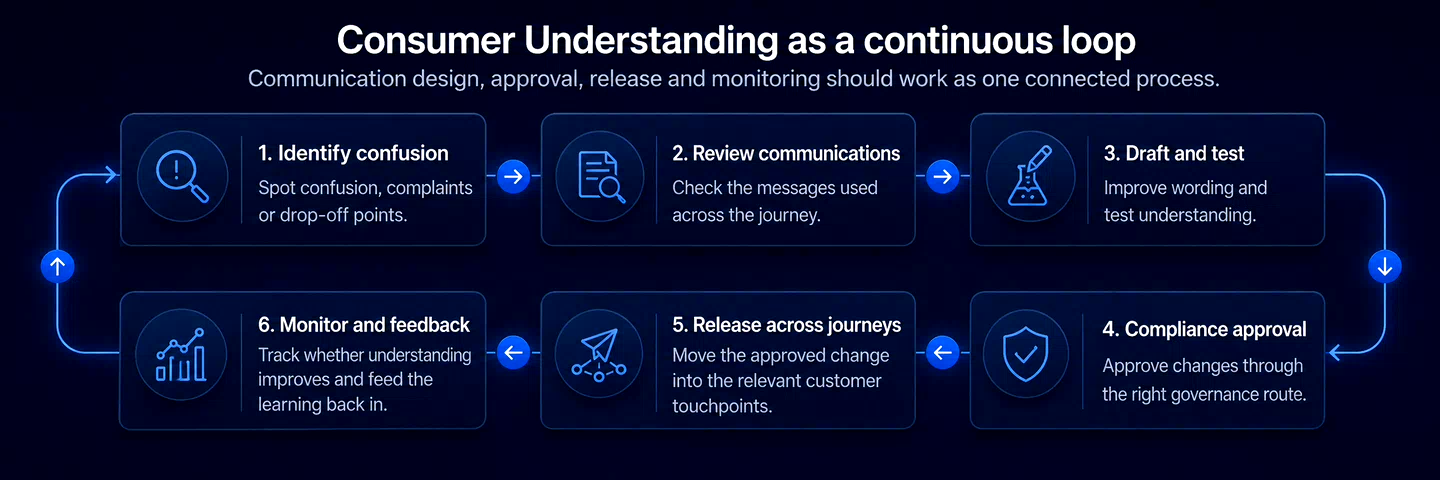
Consumer Understanding should operate as a continuous process of identifying problems, improving communications, approving changes, releasing them and monitoring the results. | ||
|---|---|---|
The final step feeds back into the first. That turns customer communication from a static collection of templates into a living part of product governance. What joined-up communication control could look likeThe FCA does not require every BNPL lender to use the same technology or workflow. Different firms will design controls that reflect their products, size, risk profile and technical architecture. A joined-up approach might nevertheless include:
The aim is not to remove human judgement. Legal, compliance, product and customer-service teams must still decide what customers need to understand and how the firm should support them. The system underneath those decisions should make it easier for the approved outcome to reach the live customer journey accurately. Where CommsPliant could fitCommsPliant is a working early-stage system that has already gone through multiple development iterations. The platform enables regulated customer communications to be created, reviewed, approved, versioned and made available to existing systems through a controlled workflow. For a BNPL provider, this could help reduce the need to manage customer wording separately across development tickets, shared documents and disconnected approval records. CommsPliant would not decide whether a credit product complies with FCA requirements. It would not perform affordability assessments, replace Consumer Duty analysis or determine how a firm should treat a customer in financial difficulty. Its role is operational: helping firms move approved communication changes from business and compliance teams into live email and PDF journeys with clearer versioning, approval control and technical integration. Regulation does not stop at the checkout buttonThe arrival of FCA regulation is an important change for the Buy Now Pay Later market. It gives consumers stronger protections before they enter an agreement and when difficulties arise later. For firms, the communication challenge will not be confined to adding more information to a checkout page. It will involve keeping the whole journey connected as the purpose and tone of the communication changes. The message that introduces the product must align with the agreement that confirms it. The payment reminder must reflect the correct schedule. The missed-payment notice must explain what has happened clearly. The financial-difficulty communication must make support visible and accessible. BNPL may begin with a quick click. Good communication control has to remain in place long after checkout. About CommsPliantCommsPliant is a working early-stage system that has already gone through multiple development iterations. The platform enables regulated customer communications to be created, reviewed, approved, versioned and made available to existing systems through a controlled workflow. It is designed to support organisations across regulated sectors, including financial services, pensions, insurance and legal services. Within the existing platform, workflows can be configured around an organisation’s approval routes, user roles, template structures, integrations and reporting requirements. Where an organisation has needs that go beyond the platform’s standard configuration, we can also explore a more bespoke solution designed around its specific operational and compliance requirements. | ||