
COBS 3A: What Your Client Categorisation Letters Need to Explain
COBS 3A changes how firms discuss professional status, warn clients and capture consent. What to review in your letters, consent journeys and client records.

The file moves. Does the flag? What CONC 7.13 says should travel with a debt
When a debt passes to a collector, do the dispute and vulnerability flags go with it? What CONC 7.13 and 7.14 say, and where the flag gets lost.
One missing paragraph: the final response that doesn’t start the six-month clock
Does a final response explain the six-month ombudsman time limit? What DISP 1.6 and DISP 2.8 say about when the clock starts, and what to check in the wording.

The debt adviser just called: what CONC 7.3.11R suspends, and for how long
A debt adviser calls to say a repayment plan is on its way. What CONC 7.3.11R suspends, how long the pause lasts, and where it breaks.

Nothing is late. Yet. When CONC 7.3 forbearance starts before arrears
A customer who has never missed a payment says next month will be hard. Why CONC 7.3 already applies, and where the early signal gets missed.

Same letter, two legal systems: old debts in England and Scotland
The same arrears template, sent to Leeds and Glasgow. Why an old debt is treated differently in England and Scotland, and what CONC 7.8 and 7.15 say.

Breathing Space has two clocks: what stops in your letter sequence
A Breathing Space notice arrives with a reminder due tomorrow. What creditors must stop, which letters may still go, and why the two types end differently.

Who else reads the envelope?
What CONC 7.9 says about third parties learning of a debt. Practical checks for the sender name, envelope and the records that show what was sent.

Which parts of a customer letter should AI be allowed to rewrite?
AI can make complaint letters clearer. Decide which wording it may rewrite, which facts must retain their meaning, and which text needs protection.

FCA information request deadlines: how to assemble the letter evidence pack
Responding to an FCA information request? Check which deadline applies and assemble a letter evidence pack linking approvals, generation, output and sending.

Forbearance letter wording: can the customer understand the support offered?
Review forbearance letters against the support offered. Check payment terms, balance and credit-file explanations, and keep creditor and agency wording aligned.

BNPL missed-payment notice: what CONC 7.20 requires
What FCA rule CONC 7.20.1R requires a missed-payment notice on regulated deferred payment credit to tell the customer, and how to check yours.
BNPL collections handover: what notice evidence should travel with the account?
What notice evidence should travel with a BNPL account? A practical checklist covering approved versions, generation records, retained outputs and sending results.
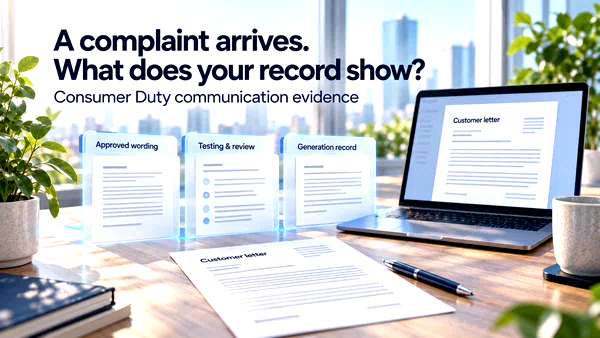
Consumer Duty communications evidence: what should your record show when a complaint arrives?
What the Consumer Duty and DISP expect when a complaint questions an arrears letter, what the FCA found in March 2026, and what your record should show.

When AI Sounds Regulated: The FCA’s Warning on Investor Trust
FCA research reveals misconceptions about AI financial information. What should firms check when AI helps shape customer communications?

Senior FCA Official Urges Financial Firms to Use ECCTA Information-Sharing Powers
A senior FCA official is urging financial firms to use ECCTA information-sharing powers as government guidance highlights audit trails and decision records.

Off-the-Shelf Controls Aren't Enough: The Operational Lesson Behind the FCA's Annex 1 Warning
The FCA is increasing scrutiny of Annex 1 firms. We look at the operational lesson for regulated communications, governance and audit-ready evidence.
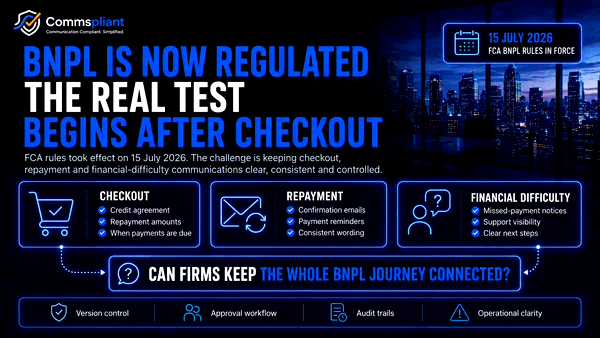
BNPL Is Now Regulated. The Real Test Begins After Checkout
BNPL regulation now reaches far beyond checkout. This practical overview explains the new UK rules, what changed, and why clear, connected customer communications matter throughout repayment and financial difficulty.
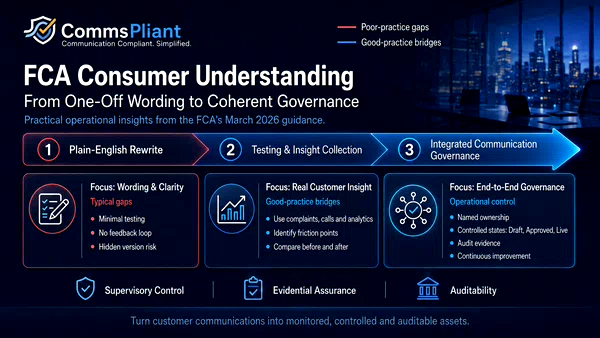
FCA Consumer Understanding: A Human Summary for Regulated Firms
A plain-English summary of the FCA’s March 2026 consumer understanding publication, with practical takeaways for regulated firms reviewing customer communications, testing, monitoring and governance.